
The Counter-Drone Drill
D-FEND SOLUTIONS BLOG
The rapid advancement of drone technology has created a complex security environment, with unmanned aerial systems serving both beneficial and harmful purposes. Recent incidents demonstrate the threat environment, as German authorities detained cargo ships suspected of launching surveillance drones, British police arrested operators flying drones near Windsor Castle, and law enforcement agencies across the United States are intercepting contraband delivery attempts at correctional facilities.
This growing range of drone incidents shows how technologies that enable innovation can also create new layers of risk, demanding advanced, controlled, and effective counter-drone responses.
As drones become more accessible and sophisticated, security professionals face increasingly complex decisions about how to respond to unauthorized aircraft. The fundamental choice lies between hard kill technologies that physically destroy threats and soft kill methods that neutralize drones through non-destructive means. Understanding the operational trade-offs between these approaches is essential for developing effective counter-drone strategies.
Each approach offers distinct advantages and limitations that must be carefully weighed against operational requirements, environmental constraints, and acceptable risk levels. Ultimately, the objective is not just to stop rogue drones, but to do so safely, effectively, and with minimal unintended consequences.
The scale of the drone threat has grown substantially in recent years. German authorities documented 536 suspicious drone flights near critical infrastructure in just the first quarter of 2025, illustrating how routine these incidents have become. What began as occasional nuisance flights by hobbyists has evolved into organized criminal activity and potential state-sponsored operations.
Criminal organizations have quickly adapted drone technology for illicit purposes, from smuggling contraband into prisons to conducting reconnaissance for theft or trafficking operations. Recent arrests in South Carolina involved suspects attempting to smuggle contraband into federal correctional facilities using drones. Traditional perimeter and surveillance measures cannot fully contain a threat that moves freely through the sky, requiring new layers of situational awareness and aerial control.
The intelligence and surveillance applications of drones present even greater concerns for national security. Modern consumer drones equipped with high-definition cameras can conduct detailed reconnaissance of sensitive facilities. Their small size, relatively low cost, and increasing autonomous capabilities make them attractive tools for espionage operations. The same technology that enables legitimate commercial applications also provides adversaries with accessible platforms for gathering intelligence or potentially delivering harmful payloads.
The accessibility of drone technology means aerial security threats are no longer limited to well-funded organizations or nation-states. Individual actors can now conduct sophisticated aerial operations with equipment available through commercial channels, fundamentally changing how security agencies and operators must think about defense.
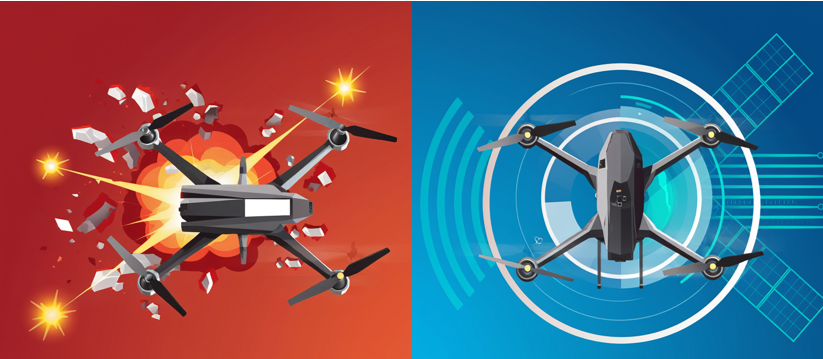
Hard kill counter-drone technologies focus on physical destruction or kinetic neutralization of threats. These systems range from traditional projectile weapons to advanced directed energy solutions, each designed to permanently eliminate the drone threat.
Kinetic solutions include various approaches, such as drone-intercepting systems that capture targets with nets or engage them directly, intelligent shooter platforms with specialized targeting systems for small aerial targets and adapted conventional weapons systems. These technologies physically intervene to stop drone operations, typically resulting in the aircraft falling from the sky.
Laser systems represent a more advanced hard kill option, using concentrated energy beams to destroy drone components or structures. These directed energy weapons can engage targets at significant distances and potentially handle multiple threats in succession. Similarly, electromagnetic pulse and high-power microwave systems deliver intense energy bursts designed to damage or destroy electronic systems within the target drone.
The primary strength of hard kill solutions lies in their decisive nature. When successfully deployed, they permanently eliminate the threat with no possibility of the drone completing its intended mission. This certainty makes them particularly valuable in high-stakes scenarios where complete neutralization is the primary objective.
Despite their definitive approach to threat elimination, hard kill technologies present several significant operational challenges.
Collateral Damage
The most critical concern is collateral damage potential. Drones neutralized through kinetic or directed energy methods typically crash uncontrollably, posing risks to people and property, particularly in urban environments or near sensitive infrastructure.
Safety
Projectile-based systems introduce additional safety considerations, as missed shots or debris can affect unintended targets. These risks are amplified in populated areas where complex environments contain numerous potential collateral damage scenarios. Even successful engagements often produce falling debris that creates secondary hazards requiring additional safety measures.
Environmental Sensitivity
Environmental factors can significantly impact hard kill system effectiveness. Laser systems require clear line-of-sight to targets and may be degraded by weather conditions, atmospheric interference, or environmental obstacles. Their performance against smaller, faster-moving drones can be inconsistent, and urban environments often present sight-line challenges.
Loss of Intelligence
The destructive nature of hard kill methods eliminates opportunities for intelligence gathering and forensic analysis, assuming such measures are allowed by regulations and performed by authorized security personnel. When drones are destroyed, investigators lose access to data storage devices, communication equipment, and other evidence that could provide valuable insights into threat networks or operational methods. This limitation is particularly significant for law enforcement agencies investigating criminal drone activities.
Cost and Complexity
Cost considerations also factor prominently in hard kill system deployment. Many kinetic solutions require expensive munitions for each engagement, while directed energy systems demand substantial power infrastructure and ongoing maintenance. Training requirements and logistical complexity add operational overhead that affects overall system viability.
Soft kill technologies offer non-destructive approaches to drone threat neutralization through disruption, or control methods. These systems have gained prominence due to their lower collateral risk profile and greater suitability for civilian operational environments.
RF jamming systems work by overwhelming drone communication channels with interference signals, disrupting the connection between operators and their aircraft. These systems vary in configuration from directional units that focus energy on specific directions to omni-directional systems that create broader interference zones. Handheld variants provide tactical flexibility for close-range scenarios. The lack of precision and potential interference with nearby communication systems makes jamming a limited solution in many environments.
Spoofing technologies broadcast false navigation signals designed to confuse drone positioning systems, potentially redirecting aircraft away from protected areas. However, these systems affect all GNSS-dependent devices in their coverage area, creating potential complications for legitimate navigation users.
While both methods can disrupt threat activity, they lack control, making them less predictable and potentially unsuitable for civilian settings where precision and accountability are essential.
RF-cyber takeover stands apart as the next evolution of soft-kill capability.Unlike jamming or spoofing, a takeover method establishes secure communications with the rogue drone, taking control over its function. Once a takeover occurs, C-UAS operators can command the drone to land safely in predetermined locations, securing both the drone and any associated evidence. This approach enables security teams to neutralize threats without collateral risk while maintaining control, situational awareness, and continuity of operations.
The key advantage of non-kinetic, soft kill methods lies in their ability to neutralize threats while preserving evidence and maintaining controlled outcomes. Intact drones provide valuable intelligence about threat capabilities, operational methods, and potential networks. Additionally, soft kill systems typically offer better scalability and can often engage multiple targets.
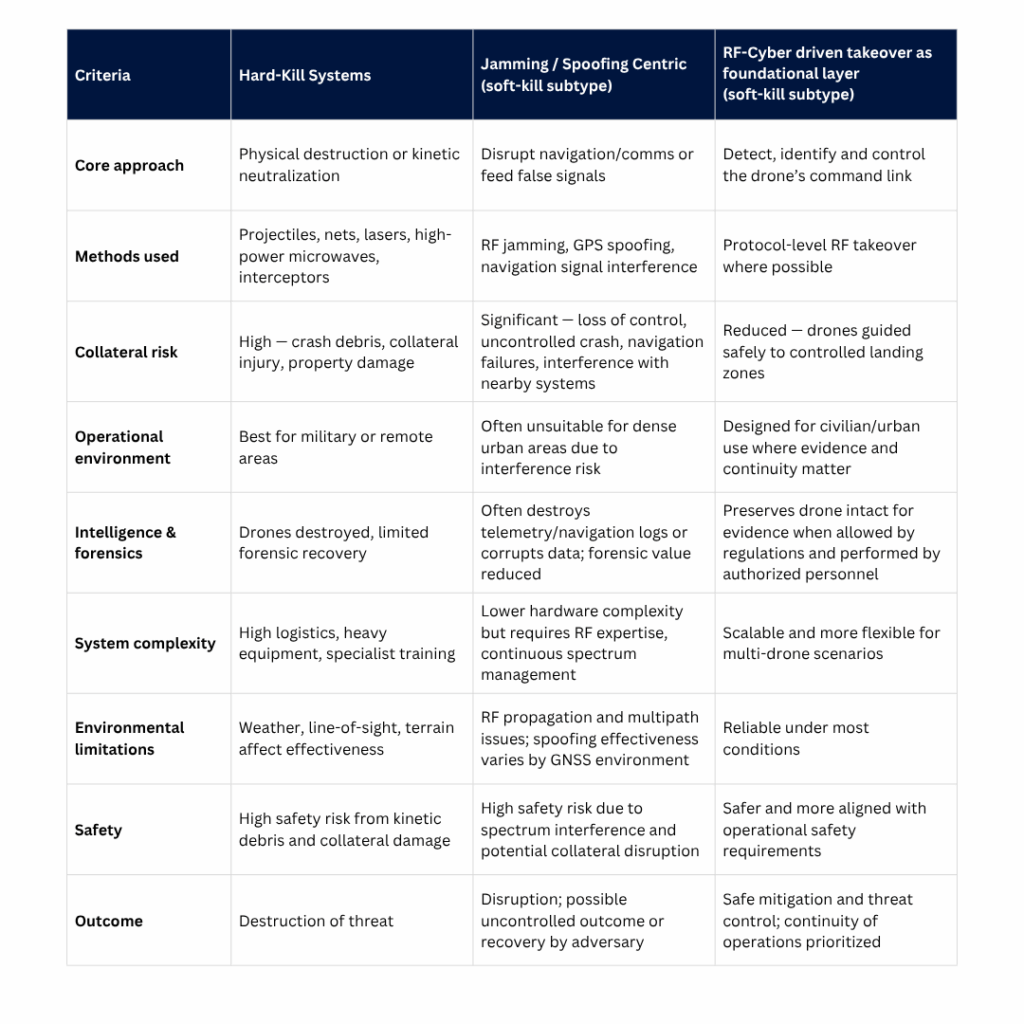
In modern operational environments, safety, precision, and, when permitted, intelligence recovery are all critical. Hard kill solutions deliver destruction—but at elevated risk and cost. Non-kinetic methods deliver control—and preserve critical situational awareness. The operational future of counter-drone systems will be defined not by force, but by control.
Industry leaders are now focusing on RF-cyber takeover as the cornerstone of next-generation counter-drone defense. This method provides safe, controlled mitigation across scenarios including law enforcement, airport protection, critical infrastructure defense, and protection during major public and sporting events.
Defense One recently observed D-Fend Solutions’ EnforceAir2 radio frequency cyber-takeover solution in action— a portable counter-drone system that can be mounted on a tactical tripod, vehicle, or carried in a backpack. The system detects and tracks nearby drones, helps operators classify them as “suspect” or “friendly,” and even lets users create a digital safe zone to isolate and take control of rogue drones.
By focusing on safe control instead of destruction, EnforceAir enables operators to achieve full threat mitigation without collateral damage. Whether deployed as a standalone system or within the multilayer EnforceAir PLUS ecosystem, D-Fend Solutions provides operational continuity, intelligence preservation, and true control of the airspace. As drone threats evolve, the future of counter-drone technology will be defined not by destruction, but by control.
Counter-drone technology includes systems designed to detect, identify, and neutralize unauthorized unmanned aerial systems (UAS). These solutions combine detection tools with mitigation capabilities to maintain safe, controlled, and secure airspace.
Hard-kill systems physically destroy or disable drones using kinetic or directed-energy means. Soft-kill methods neutralize threats non-destructively through disruption or control techniques such as RF-cyber takeover.
They often cause uncontrolled drone crashes, creating risks to people and property, especially in populated areas. Hard-kill approaches also eliminate any intelligence value by destroying onboard data and components.
RF-cyber takeover allows operators to take control of unauthorized drones and guide them to secure landing zones. This method provides precision, safety, and intelligence preservation- key advantages over traditional hard-kill techniques.

 Subscribe to email updates
Most Popular
Military forces, airports, borders, and prisons all ...
On July 21, 2022, a drone incident at Ronald Reagan ...
Drone Proliferation: The Good, the Bad, and the ...
Our Bloggers
Tags