
The Counter-Drone Drill
D-FEND SOLUTIONS BLOG
Part 2 of the Counter-UAS evaluation series examines mitigation capabilities, operator control modes, performance validation, usability, and long-term scalability. It outlines how a structured evaluation process supports selection of a future-ready Anti-UAV defense System aligned with evolving drone threat environments.
Organizations confronting unauthorized drone threats face decisions extending beyond technology selection to encompass operational integration, and strategic program development. Counter-drone professionals benefit from frameworks that evaluate counter-UAS technologies through multiple lenses: technical capabilities, operational suitability, financial sustainability, and organizational alignment.
Asking the right questions throughout the evaluation process helps ensure investments translate into real, ensuring operational capability rather than nominal performance on paper.
Part 1 of this series raised some often overlooked issues in assessing detection architectures and operational requirements. This continuation of the series addresses critical questions surrounding mitigation technologies, system performance verification,, and the development of future-ready anti-UAV defense systems. Below are 5 more often-overlooked factors for counter-drone professionals to consider when evaluating counter-UAS systems:
Mitigation represents the decisive phase of counter-drone operations, the moment when organizations neutralize unauthorized drone threats. However, mitigation technologies vary dramatically in methodology, effectiveness, and operational implications.
Airports, critical infrastructure facilities, and urban settings cannot afford disturbance of legitimate communications, navigation systems, or essential operations. Organizations operating in these contexts require non-disruptive, non-kinetic approaches that neutralize threats without compromising safety and operational continuity.
RF cyber-takeover technology such as that employed by D-Fend Solutions’ EnforceAir, is a non-kinetic, non-disruptive approach that provides end-to-end detection and mitigation for situational awareness, operational continuity, and safe, controlled outcomes. Counter-drone professionals benefit from this precision as threats are neutralized without collateral damage, communications are preserved, and operational continuity is maintained throughout the incident lifecycle.
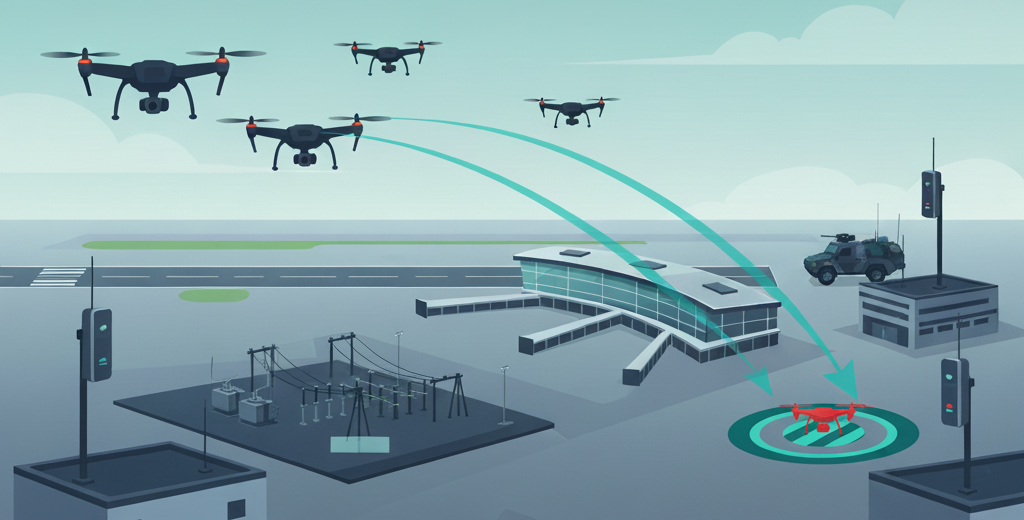
A C-UAS system’s value depends not just on what it can do autonomously, but on how well it empowers human decision-making when situations require direct operator judgment. Many evaluations treat automation as inherently superior, but operational reality is more nuanced.
Counter-drone professionals should evaluate whether a system supports both modes natively. EnforceAir provides end-to-end detection and mitigation for situational awareness, operational continuity, and safe, controlled outcomes. Whether operating autonomously or manually, the system detects, locates, and identifies rogue drones in protected airspace, then neutralizes threats through RF cyber-takeovers functioning as a standalone, multilayer, or integrated system to ensure safe landings and controlled outcomes.
Organizations should insist on live demonstrations in environments that closely mirror their intended use cases. An airport setting poses very different challenges than a border environment or a critical infrastructure site, each with its own profile, terrain characteristics, and operational tempo. A system that performs well in one scenario may fall short in another, even if vendor specifications appear similar on paper.
Ideally, demonstrations should reflect representative conditions, and operational constraints, so decision-makers can validate both performance and usability in context.
Even the most capable anti-UAV defense system can fail operationally if its interface overwhelms operators at the moment it matters most. Evaluators often focus heavily on what a system can do technically, while underweighting how easily and quickly operators can act on that information under stress. The operator’s experience including how information is displayed, how rapidly a threat can be assessed, and how few steps it takes to initiate a response can be the deciding factor in a real incident. A complex interface that requires extensive training or multi-step processes introduces dangerous latency into threat response.
EnforceAir’s tablet-based command center addresses this directly through a user-friendly Graphical User Interface (GUI) designed to simplify airspace management and empower authorized personnel to make critical decisions swiftly and efficiently. Setup of mission plans, protection zones, and drone classifications is streamlined through an intuitive interface, while an interactive map delivers real-time situational awareness with detailed drone data at a glance. The software’s modular, future-proof design allows for growth and upgrades over time, and the ruggedized tablet is built to withstand drops, bumps, and other harsh field conditions ensuring the interface remains reliable precisely when and where it is needed most.
Counter-UAS technologies continue to evolve rapidly, with new approaches and capabilities emerging that counter-drone professionals must carefully consider. Counter-drone professionals must ensure the technology they invest in remains future-ready and can accommodate evolving operational needs. Organizations should evaluate the vendor’s update cadence, the mechanisms for deploying updates, and whether enable seamless capability enhancement without operational disruption.
EnforceAir is built to evolve. Its software-defined, AI-enhanced architecture enables seamless integration of new capabilities, helping organizations stay ahead of emerging drone threats. Continuous software updates reflect a long-term commitment to keeping the system effective as tactics change. This future-ready approach ensures that security investments remain relevant for years, without forcing costly system replacements as the threat landscape evolves.
Effective anti-UAV defense systems balance present operational requirements against future capability needs. Technologies built on adaptable architectures, supporting multilayer integration and clear innovation roadmaps, enable organizations to evolve with emerging threats without requiring full system replacement. A vendor’s global deployment footprint further reflects operational maturity and experience, allowing performance claims to be validated through real-world use across relevant sectors.
Advanced RF-cyber driven technologies enable a seamless process between awareness and response, allowing teams to deeply understand drone behavior, locate associated operators, and execute precise, controlled actions that remain effective as aerial threats continue evolving.
The questions outlined across this two-part series raise various lesser known evaluation factors addressing technical capabilities, operational requirements, and program sustainability.
Organizations that systematically evaluate detection capabilities, mitigation methodologies, operational flexibility, performance validation, and long-term sustainability position themselves to make informed decisions that deliver genuine security value. This disciplined approach distinguishes effective Counter-UAS programs from reactive technology acquisitions that fail to address fundamental operational requirements.
The Counter-UAS market continues maturing as organizations gain operational experience, and technologies advance. Counter-drone professionals contribute to this maturation by demanding rigorous performance validation, transparent capability disclosure, and vendor accountability for operational effectiveness.
The drone threat will continue evolving in sophistication, scale, and diversity. By considering these often overlooked issues , counter-drone professionals strengthen their ability to manage today’s rogue drone threats while preparing for tomorrow’s challenges. Continued collaboration across industry, operations, and policy will be essential to shaping a resilient, secure, drone-enabled environment guided by intelligence, control, and continuity.
Mitigation approaches vary in methodology and operational impact. Organizations operating in airports, critical infrastructure, and urban environments should assess whether a system offers non-kinetic, non-disruptive mitigation that neutralizes unauthorized drones without disturbing essential communications or operations.
Operational environments differ, and incidents may require either automated response or direct operator judgment. A system that supports both autonomous and manual modes enables flexibility while maintaining situational awareness and controlled outcomes.
Demonstrations in representative environments allow organizations to validate system performance, usability, and operational fit under realistic conditions rather than relying solely on vendor specifications.
Interface clarity and cognitive load directly influence response speed during live incidents. Systems that simplify mission setup, display real-time airspace data clearly, and reduce multi-step processes improve operational effectiveness.
Future-ready counter-UAS platforms rely on software-defined architecture and structured update mechanisms. Continuous software updates and modular integration capabilities enable systems to evolve alongside emerging drone technologies without disrupting ongoing operations.

 Subscribe to email updates
Most Popular
Military forces, airports, borders, and prisons all ...
On July 21, 2022, a drone incident at Ronald Reagan ...
Drone Proliferation: The Good, the Bad, and the ...
Our Bloggers
Tags