The Counter-Drone Drill
D-FEND SOLUTIONS BLOG
Drone detection has improved dramatically in recent years, yet organizations continue to face a persistent operational challenge: false positives that trigger unnecessary responses, drain resources, and erode operator trust. In mission-critical environments, airports, military bases, mass events, and critical infrastructure, operators need accurate alerts and minimal disruption. False positives undermine all three.
This article examines why false positives occur in drone detection, how they impact operational readiness, and how advanced radio frequency (RF) cyber capabilities and multilayer fusion technologies, such as D-Fend Solutions’ EnforceAir systems, set a new standard for accurate, reliable, and verification-driven counter-drone measures.
A false positive occurs when a drone detection system incorrectly interprets a harmless signal or object as a drone threat. In counter-unmanned aircraft systems (C-UAS) operations, this can include misinterpreting signals from numerous consumer devices, or even detecting birds as drones, (in locations where birds are active, field trials have demonstrated high false positive rates).
RF sensors face the challenge of distinguishing drones from countless consumer electronics using those same frequencies, a task complicated when detection distances extend past 1km. These conditions challenge operators and complicate security workflows, especially where response times are critical.
Understanding the root causes of false positives is essential to address them effectively. Several interconnected factors contribute to this challenge. Urban architecture, reflective materials, and electromagnetic noise complicate precise signal interpretation. Severe environmental factors can impair the precision and resilience of sensors, such as radar or optical systems, leading to false positives. Commercial drones share frequency bands with consumer devices. Here, the challenge becomes distinguishing drone protocols from routine wireless activity.
When security operators encounter repeated false alarms, their response patterns change. Initial vigilance gives way to skepticism. Teams start developing informal rules about which alerts to take seriously. Response protocols degrade as personnel wait for additional confirmation before acting. A genuine threat can exploit the gap created by operator distrust of their own systems.
In December, reports indicated that over 5,000 drone sightings investigated in New Jersey were ultimately identified as small aircraft, recreational drones, helicopters, stars, or law enforcement vehicles rather than actual rogue drones. Multiple federal agencies, including the Department of Homeland Security and the Department of Defense, issued a joint statement as increased reports of drone activity across New Jersey and the broader Northeast gained national attention.
According to the statement, after reviewing technical data and citizen tips, officials concluded that the sightings consisted of lawful commercial and hobbyist drones, law enforcement drones, and manned airplanes and helicopters mistakenly perceived as drones. They emphasized that nothing unusual had been detected and that the activity did not pose any national security or public safety risk in New Jersey or other Northeastern states.
In facilities running 24/7 security operations, these costs add up quickly when false positive rates reach double digits. The most serious consequence is how false positives affect response to real threats. When operators lose confidence in detection systems and response times slow, the window for effective intervention narrows. In airspace security where drones move quickly, minutes matter.
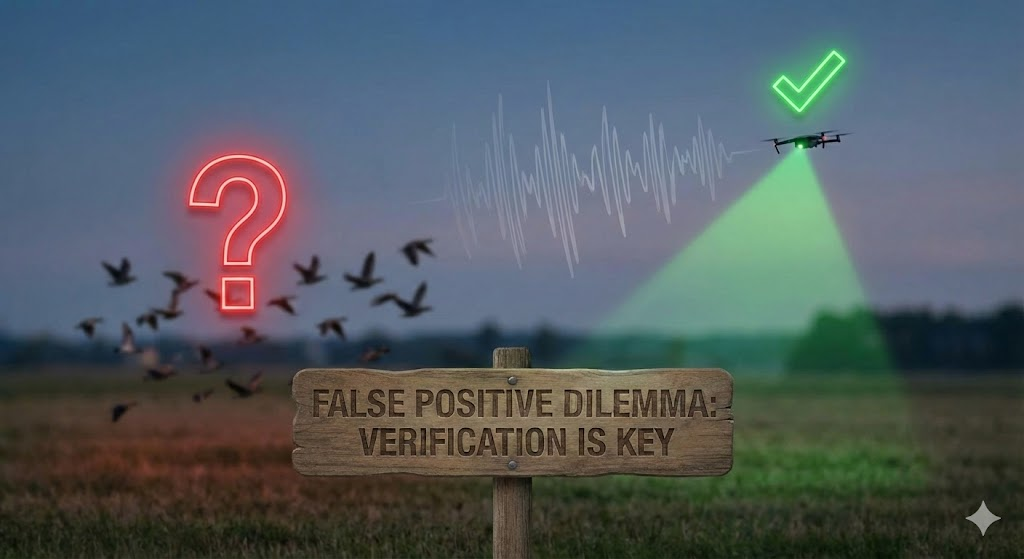
Regulatory frameworks and industry standards have evolved to recognize something fundamental, that is, detecting a potential threat is only the first step in effective, controlled airspace security. Operators need to review alerts and confirm with evidence when airspace is clear.
The EASA drone incident management handbook also advises that upon receiving reports of possible drone activity at or around an aerodrome, the principal stakeholders should work in close coordination through established protocols for collecting information, confirming its accuracy, and sharing communications to achieve optimal situational awareness and determine whether the information on the drone is sufficiently reliable to warrant declaring an incident.
Traditional C-UAS technologies may generate false positives as part of how they operate. Each sensing modality carries trade-offs and the limitation of the detection technology may cause the misidentification. For instance, legacy radar systems offer long-range coverage but may struggle to tell small drones apart from birds or other flying objects. They’re also complex to operate and challenging to integrate with mitigation systems.
RF-Cyber solutions take a different approach. These systems passively, continuously scan and detect unique communication signals used by commercial drones. This approach produces zero false positives because the system detects and understands actual drone communication protocols rather than trying to infer drone presence from indirect indicators.
Once the system detects a drone signal, it identifies and classifies the aircraft as authorized or unauthorized. The system determines drone type and provides accurate location information, including the pilot and take-off location in real-time. This gives law enforcement actionable intelligence. These systems can work even when noise levels or line-of-sight constraints would stifle other technologies. RF-Cyber detection delivers a high degree of certainty: once a drone’s communications is detected, its presence is further confirmed, with minimal false alarms.
EnforceAir PLUS integrates multiple technologies “out-of-the-box” in an unprecedented way. The platform combines field-proven RF-Cyber Takeover with complementary capabilities including radar, advanced drone identification, and a smart RF-effector last resort jamming option. These components work together in a compact, fully integrated system.
The optimized radar detection extends threat coverage beyond what cyber measures alone provide, while maintaining minimal false positives. Integration with compact multi-panel solid-state radar from leading providers enhances airspace accuracy without sacrificing reliability. The smart RF-effector jamming option adds a software-defined RF defensive layer.
RF-Cyber technology forms the foundation of EnforceAir’s performance. The system maintains intuitive setup and streamlines workflows while supporting operational confidence with minimal training requirements.
Cyber and Artificial intelligence (AI) are changing the way C-UAS systems handle false positives. Recent developments show that AI-assisted approaches can reduce false alerts substantially while maintaining detection sensitivity. EnforceAir PLUS incorporates AI-enhanced capabilities. The SmartAir AI engine combines data from RF-Cyber and radar sensors into a unified airspace view, providing operators with actionable intelligence. This approach focuses on genuine threats, while significantly reducing the false positive burden that affects traditional systems.
Detection without verification creates gaps in security. Organizations need comprehensive workflows that include confirmation, and clear all-clear procedures. Cyber capabilities accelerate verification while significantly reducing false alarm rates. Effective counter-drone defense requires combining RF-Cyber technology with multilayer capabilities and solid verification protocols. This integrated approach gives operators the confidence and situational awareness they need when genuine threats appear.
Reducing false positives is not about convenience. It is about operational efficiency. By significantly reducing false alerts through RF-Cyber and its inherently more accurate detection, EnforceAir enables security teams to focus on real threats with confidence, clarity, and control in increasingly complex airspace environments.
A false positive occurs when a drone detection system identifies a non-drone object or signal as a drone threat, such as birds or aircraft operating in similar frequency ranges.
False positives strain operational resources, slow response times, and reduce operator confidence. Over time, repeated false alerts can cause teams to hesitate when a real drone threat appears.
Common causes include environmental conditions, electromagnetic congestion, shared frequency bands with consumer devices, and sensing technologies that rely on indirect indicators rather than verified drone communications.
Verification allows operators to confirm whether an alert represents a real drone threat before escalating a response. This reduces unnecessary disruptions and supports reliable airspace security operations.
RF-Cyber technology focuses on identifying actual drone communication protocols, rather than inferring drone presence from radar reflections or visual cues. This verification-driven approach significantly reduces false alerts.
Multilayer systems combine RF-Cyber technology with complementary detection layers, such as optimized radar, to expand coverage while maintaining low false positive rates and a clear operational picture.

 Subscribe to email updates
Most Popular
Military forces, airports, borders, and prisons all ...
On July 21, 2022, a drone incident at Ronald Reagan ...
Drone Proliferation: The Good, the Bad, and the ...
Our Bloggers
Tags