
The Counter-Drone Drill
D-FEND SOLUTIONS BLOG
AI Summary
Drone incidents in 2025 show a shift from isolated events to persistent, patterned activity that challenges traditional counter-UAS operations. As low-cost drones are used more deliberately, counter-UAS challenges now focus on sustaining situational awareness, precise identification, and controlled response in active airspace.
The rogue drone activity in 2025 reflects a clear transition from sporadic or inadvertent airspace violations to more deliberate, repeatable operations. Beyond the known and accepted increase in incident numbers, is the change in behavior. Incidents in 2025 increasingly show persistence, planning, and an apparent understanding of regulatory, operational, and detection limitations. Activity is no longer random or isolated. Instead, it reflects purposeful use of drones in environments where nefarious operational disruption, intelligence collection, or access enablement can be achieved with minimal exposure, a defining factor in today’s counter-UAS challenges.
Maintaining consistent situational awareness and control has become central as unauthorized drone activity becomes a persistent feature of the operating environment.
A defining characteristic of 2025 is the use of commercially available drones as tools of deliberate disruption rather than casual observation. Rogue drone pilots are increasingly leveraging low-cost UAVs to conduct reconnaissance, enable smuggling, or create temporary denial of airspace.
This trend is visible across both civilian and military contexts. On June 1, 2025, Ukraine conducted what became known as Operation Spider’s Web, a coordinated deep-strike operation using commercially available drones against multiple Russian military airfields. While distinct from civilian drone incidents, the operation illustrates a broader operational reality that simple, widely available platforms can have strategic impact when planning, coordination, and timing are aligned.
For counter-drone professionals, the focus is shifting from reactive response to sustained readiness. The challenge is no longer determining whether an incident will occur, but ensuring the ability to detect, assess, and mitigate drone activity with speed and precision. Reviewing recent incidents highlights how detection and mitigation approaches must continue evolving, reinforcing the need for precise, controlled, and non-kinetic responses that preserve operational continuity and situational awareness.

Throughout 2025, drone incidents increasingly followed identifiable patterns, indicating reconnaissance cycles or response testing rather than mere isolated misuse.
This was particularly evident in aviation environments. In Belgium, a sequence of drone-related incidents occurred within a short timeframe. On November 4, 2025, Brussels Airport was forced to close twice, resulting in 54 flight cancellations and widespread passenger disruption. On November 7, Liège Airport suspended operations for approximately 30 minutes following a drone sighting. Five days later, on November 12, Brussels Airport again halted operations, diverting passenger flights to Liège and cargo aircraft to Cologne. The operational impact of these incidents was disproportionate to the technical capability of the unauthorized drones involved, highlighting how uncertainty and safety protocols alone can generate cascading effects when airspace control is compromised.
A similar pattern emerged at military installations. On October 3, 2025, multiple drones were detected over the Elsenborn military training area near the German border. This was followed by repeated drone activity between October 31 and November 2 over Kleine-Brogel Air Base, where surveillance of F-16 operations was reported. The persistence and timing of these events suggest deliberate monitoring and pattern-of-life collection rather than accidental overflight.
Correctional facilities experienced comparable trends. Between February 3 and February 7, multiple rogue drone incursions were recorded at HMP Hindley and HMP Manchester, United Kingdom. HMP Long Lartin was targeted repeatedly on April 6, April 14, and May 19, before another coordinated incident occurred on August 10 involving both Long Lartin and HMP Lowdham Grange. The frequency, timing, and coordination of these events indicate a structured operational model exploiting predictable response windows and security routines.
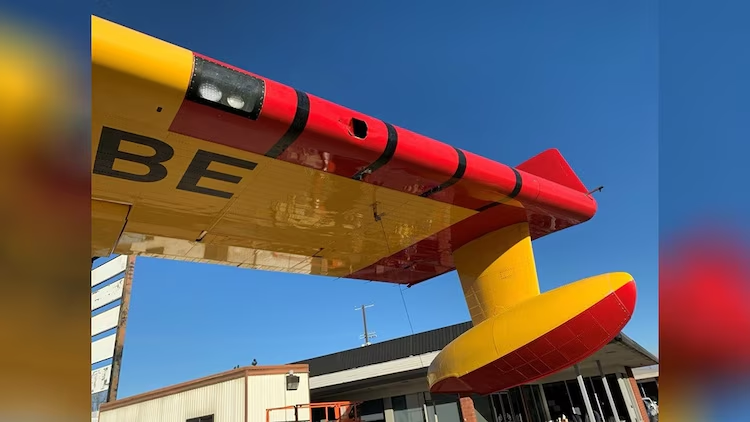
A damaged firefighting aircraft is seen after a drone strike while responding to the Palisades Fire on Jan. 9, 2025, FBI
Several incidents in 2025 further demonstrated how unauthorized drone activity increasingly affects operational continuity beyond security domains.
During the Palisades Fire in Los Angeles, a civilian drone collided with a “Super Scooper” firefighting aircraft, damaging the wing and removing a critical aerial asset from service during active fire suppression operations. The incident highlighted how a single unauthorized drone can directly degrade emergency response capability when airspace is not effectively controlled.
In the United Kingdom, two individuals were arrested for operating drones near Windsor Castle ahead of U.S. President Trump’s state visit, exposing vulnerabilities in protected airspace management. Separately, in Waco, Texas, an Amazon Prime Air MK30 drone severed an overhead internet line following a delivery, illustrating how expanding commercial drone operations introduce new infrastructure dependencies and risk vectors.
Across these cases, the common thread is not intent alone, but the growing operational consequences of insufficient airspace control, a recurring theme across current counter-UAS challenges. D-Fend’s Drone Incident Tracker provides a growing knowledge base of trends, helping organizations assess their own risk against real-world incidents across sectors and geographies.
The 2025 incident landscape makes clear that effective counter-UAS operations now depend on early detection, precise identification, and controlled response executed within an integrated operational framework, designed to address evolving counter-UAS challenges at scale. As rogue drone activity becomes more deliberate and persistent, the ability to rapidly classify airspace activity and assess intent is increasingly central to maintaining situational awareness and operational continuity. Artificial intelligence (AI)-enhanced detection and analytics are playing a growing role in managing this complexity, enabling real-time tracking, behavioral assessment, and predictive insight that support informed decision-making at scale.
At the same time, mitigation approaches are shifting toward non-kinetic, controlled outcomes that preserve safety and continuity, particularly in sensitive or populated environments where disruption is not acceptable. These developments place greater emphasis on adaptable technologies capable of evolving alongside emerging drone threats, as well as on centralized command structures that integrate detection and response into a cohesive operational picture.
Looking ahead, the counter-UAS challenge is no longer responding to isolated drone events but sustaining control in an increasingly active low-altitude airspace. Organizations that combine early awareness, intelligent automation, and precise, non-disruptive mitigation will be best positioned to maintain security, resilience, and operational stability as unauthorized drone activity continues to expand. For counter-drone teams, these 2025 trends underline the need to move from ad-hoc responses to structured, data-driven C-UAS programs built on continuous monitoring, clear procedures, and future-ready technologies.
2025 drone incidents show that counter-UAS challenges increasingly center on persistent activity, patterned operations, and the operational impact of uncertainty. The issue is less about isolated drone sightings and more about sustaining situational awareness and controlled response in continuously active airspace.
Repeated incidents indicate planning, testing of responses, and exploitation of predictable procedures. This shifts counter-UAS challenges from event-based response to long-term operational readiness and coordination across detection and mitigation functions.
Across both domains, drone activity is becoming more deliberate and operationally impactful. While contexts differ, the shared challenge is maintaining continuity and control as low-cost platforms are used in increasingly strategic ways.
Low-cost, widely available drones reduce barriers to repeated and coordinated activity, allowing operators to test responses and exploit uncertainty without significant investment. This creates counter-UAS challenges that are less about the sophistication of the platform and more about persistence, timing, and operational impact.

 Subscribe to email updates
Most Popular
Military forces, airports, borders, and prisons all ...
On July 21, 2022, a drone incident at Ronald Reagan ...
Drone Proliferation: The Good, the Bad, and the ...
Our Bloggers
Tags