The Pentagon’s New Approach
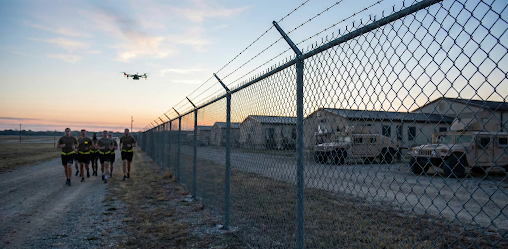
Military drone protection is rapidly evolving as unauthorized drone activity becomes a persistent threat to U.S. military bases. New Department of War (DoW) guidance expands commanders’ authority to detect, assess, and mitigate drone threats before they reach base perimeters. This shift marks a transition from reactive defense to proactive, intelligence-driven protection strategies, supported by advanced technologies such as RF-Cyber counter-UAS systems.
In January 2026, the Department of War (DoW) issued updated guidance that significantly changes how U.S. military installations can respond to unauthorized drone activity. Base commanders now have expanded authority and flexibility to counter drone incursions within sight of protected military areas, including the ability to assess and act on threats before drones physically cross installation perimeters [1].
This change reflects a broader strategic realization inside the Pentagon: that small unmanned aircraft systems are no longer isolated low-level threats. They are persistent intelligence-collection platforms and force multipliers for adversaries.
From Fence Line Defense to Proactive Drone Protection
For years, domestic counter-drone authority relied heavily on 10 U.S.C. §130i [5], which allowed the DoW to protect certain designated facilities from unmanned aircraft. While important, that framework was limited. It applied only to specific installations and often emphasized response once a drone had already crossed into restricted airspace.
The new guidance, issued through Joint Inter-Agency Task Force 401 (JIATF 401), shifts that posture. Brigadier General Matt Ross, director of JIATF-401, stated clearly: “Countering drones does not start and stop at the fence line” [3]. The updated policy allows commanders to evaluate suspicious drone activity as a threat based on the totality of circumstances, even before a perimeter breach, strengthening proactive military drone protection capabilities.
A formal government release announcing the updated guidance explains that the new framework is intended to close operational gaps and provide clearer authority for installation-level response [3]. The release emphasizes the evolving nature of the threat environment and the need for timely, localized decision-making.
Breaking Defense reports that the Pentagon expanded the task force’s authorities and clarified the role of installation commanders to reduce procedural friction and enable more agile responses [2]. This consolidated base defense policy reflects lessons learned from recent drone activity near military installations across the United States and overseas.
DefenseScoop adds that the DoW acted in part after internal reviews and Inspector General Platte Moring findings identified inconsistencies and limitations in how counter-drone policies were applied across installations [4]. The policy update is therefore not only reactive to incidents, but corrective in nature.
The 60-Day Plan Requirement
Under the updated guidance, installation commanders must submit revised counter-drone defense plans within 60 days [3]. These plans must outline how the base will detect, assess, and mitigate drone threats under the expanded authorities.This requirement reinforces accountability and urgency. Commanders are expected to conduct drills, identify vulnerabilities, and coordinate more closely with law enforcement and federal partners.
The shift signals that counter-UAS readiness is no longer optional or site-specific. It is now an institutional requirement.
Why This Change Is Necessary
The small unmanned aircraft system (sUAS) threat has evolved into a persistent operational and force protection challenge.
Commercial and DIY drones are inexpensive, widely available, and increasingly capable. They can conduct reconnaissance missions over sensitive installations with minimal risk to the operator. They can map infrastructure, monitor activity patterns, and test response times, enabling adversaries to map infrastructure, observe operational patterns, collect intelligence, and assess security posture and response timelines.
Recent global conflicts have shown how even low-cost UASs can generate outsized operational effects, such as in Operation Spiderweb [6] and the October 7 [7] attacks. At home, unauthorized drone flights near military facilities have raised concerns about surveillance and probing activity. Senior defense officials have acknowledged that such activity can reveal vulnerabilities in detection and response systems [1][2].
The updated policy recognizes that installations in the continental United States operate under complex constraints. They are often adjacent to civilian airspace, public infrastructure, and populated areas. Commanders must protect their installations without causing collateral damage or disrupting legitimate operations.
The Operational Value of RF-Cyber Technology
Base commanders should strongly consider the cutting edge RF-Cyber technology as a foundational layer of their installation Counter-UAS (CUAS) strategy, as allowed by regulations and used by authorized personnel.
RF-Cyber based CUAS systems provide capabilities that perfectly match the intent of the new DoW guidance and align with modern military drone protection requirements
First, RF-Cyber technology delivers precise detection and identification of commercial and DIY drones, including the ability to distinguish between authorized and unauthorized platforms. By passively monitoring drone communication links, RF-Cyber systems enable commanders to understand what is operating in their airspace before deciding on mitigation.
Second, RF-Cyber enables controlled mitigation/defeat. Rather than relying immediately on kinetic or other high-impact measures, operators can assume control of an unauthorized drone and guide it to a predefined safe landing zone. This reduces the risk of falling debris, limits collateral damage, and preserves valuable intelligence for follow-on investigation. Many military bases are located in urban/semi-urban areas making the non-jamming, non-kinetic nature of RF-cyber mitigation an ideal solution.
Third, RF-Cyber systems are engineered to mitigate/defeat unauthorized drones while preserving friendly communications and ongoing mission operations. Military installations often operate in spectrum-dense environments that support aviation activities, command-and-control networks, and critical infrastructure. A precise surgical response that isolates and addresses only the unauthorized aircraft is essential to maintaining operational continuity in these complex environments.
Fourth, RF-Cyber technology operates effectively in dense urban environments. Detection is passive, and can function day and night, in adverse weather conditions and without relying on visual line of sight.
Fifth, RF-Cyber provides a cost-effective defense. It requires a relatively low initial investment compared to high-end kinetic or directed energy systems. The cost to defeat is extremely low because mitigation is software-driven rather than dependent on expendable interceptors. This approach offers effectively unlimited magazine depth, making it particularly well suited for sustained operations or swarm scenarios. This also makes RF-cyber an ideal foundational layer on which to build a multi-layered system if needed.
A Strategic Inflection Point
The Pentagon’s updated counter-drone guidance marks a true strategic inflection point in military base defense.
As Brigadier General Ross stated, “Countering drones does not start and stop at the fence line” [3]. That observation reflects a broader reality. The small drone threat is persistent, adaptive, and increasingly strategic in nature. It is no longer a tactical nuisance to be handled reactively. It is a standing vulnerability that must be addressed proactively and intelligently.
This policy update recognizes that installations must be prepared to detect, assess, and respond to drone activity before it becomes an incident. It shifts responsibility closer to the installation level and calls for technologies that support precision, accountability, and operational continuity.
RF-Cyber CUAS technology aligns directly with this new policy environment. Its passive and accurate detection enables early awareness without exposing positions or disrupting friendly systems. Its controlled mitigation/defeat capabilities allow commanders to neutralize threats safely and deliberately, whether operating at domestic bases or in overseas environments.
The threat has evolved. The authorities have evolved. Installation CUAS defense will evolve, and D-Fend is positioned to enable rapid, scalable implementation in support of commanders exercising their expanded authorities.
References
[1] Military Times, “US base commanders to have more say in defeating drone intrusions,” January 27, 2026
https://www.militarytimes.com/news/your-military/2026/01/27/us-base-commanders-to-have-more-say-in-defeating-drone-intrusions/
[2] Breaking Defense, “Pentagon expands task forces, counter-drone authorities, handing commanders more flexibility,” January 2026
https://breakingdefense.com/2026/01/pentagon-expands-task-forces-counter-drone-authorities-handing-commanders-more-flexibility/
[3] Department of War / JIATF-401 Official Release, “JIATF-401 announces updated guidance to counter drone threats in the homeland,” 2026
https://www.war.gov/News/Releases/Release/Article/4389392/jiatf-401-announces-updated-guidance-to-counter-drone-threats-in-the-homeland/
[4] DefenseScoop, “US military counter-drone authorities expanded as Pentagon consolidates base defense policy,” January 26, 2026
https://defensescoop.com/2026/01/26/us-military-counter-drone-authorities-base-defense-hegseth/
[5] 10 U.S.C. 130i – Protection of certain facilities and assets from unmanned aircraft
https://www.govinfo.gov/app/details/USCODE-2016-title10/USCODE-2016-title10-subtitleA-partI-chap3-sec130i
[6] Operation Spider’s Web Examined: Practical Lessons for Security Leaders
https://info.d-fendsolutions.com/operation-spiders-web-2025-lp?utm_source=unmannedsystemstechnology.com&utm_medium=referral
[7] Life and Death in the Hands of the Drone: The Small, Cheap Devices Early in the Swords of Iron War
FAQ – Military Base Drone Protection
What is the new DoW guidance regarding military drone protection? The updated Department of Defense guidance expands the authority of base commanders to detect, assess, and respond to unauthorized drone activity before it reaches military installation boundaries. It emphasizes proactive threat evaluation, faster decision-making at the installation level, and the integration of technologies that enable precise and controlled mitigation while maintaining operational continuity.
Why is military drone protection becoming more important? Drone threats are increasing due to the accessibility and capabilities of commercial UAVs. These drones can conduct surveillance, gather intelligence, and test defenses, making proactive protection essential.
How does the new DoW guidance improve drone protection? The updated guidance allows commanders to act on drone threats before they reach base perimeters, enabling earlier detection, faster response, and more effective risk mitigation.
What technologies are used for military drone protection? Technologies include RF-based detection systems, radar, optical sensors, and RF-Cyber takeover solutions that allow controlled mitigation without disrupting surrounding systems.
Why is non-kinetic mitigation preferred in military bases? Non-kinetic solutions, such as RF-Cyber takeover, reduce collateral damage, preserve intelligence, and maintain operational continuity, especially in complex or urban environments.




 Subscribe to email updates