Counter UAV Readiness
Counter UAV readiness is becoming a national priority in the U.S., driven by new policy frameworks, local authority expansion, and the need to protect airspace, infrastructure, and future aviation systems from evolving drone threats.
The United States is finally moving from recognizing the drone threat to building a rigorous counter UAV policy framework to address it. With the SAFER SKIES Act (passed as part of the FY26 NDAA) and the White House Executive Order on Restoring American Airspace Sovereignty, the nation has acknowledged a hard truth: drones pose an immediate risk to airports, public events, and critical infrastructure that federal authorities cannot manage alone.
A primary challenge in this transition is the weight of history. We must avoid relying on legacy regulations written for a different era when the airspace was simpler and the primary threats were piloted aircraft.
In February 2026 public guidance describing a Dec. 2025 policy memorandum, the Department of War (DoW) emphasized this shift, stating that new guidance was necessary to consolidate “outdated memoranda that were inadequate to address the current, complex UAS threat environment.” The administration is pushing for a “culture shift” that empowers commanders and local authorities to move away from 20th-century bureaucracy and toward real-time operational flexibility.
A Unified Front Against Evolving C-UAV Threats
This shift has strong bipartisan support. Senator Gary Peters (MI) recently noted that as drone technologies evolve, “we must take every step necessary to ensure law enforcement can respond to threats that drones could pose to sporting events, large gatherings and critical infrastructure.”
The White House Executive Order reinforces this by calling for stronger control over drones in the U.S. airspace. The administration has explicitly warned that “criminals, terrorists, and hostile foreign actors have intensified their weaponization of these technologies,” specifically citing the use of UAVs by cartels to surveil law enforcement and smuggle contraband.
Enabling the “First to React”
The core of the new policy is a practical reality shaping counter UAV operations: the threat is often local, while the ability to respond has historically been federal. The SAFER SKIES Act changes this by creating a pathway for qualified state, local, tribal, and territorial (SLTT) agencies to gain counter-UAS authority.
To support this, DHS recently launched a new Program Executive Office for UAS and C-UAS, which is overseeing a $1.5 billion contract vehicle to quickly acquire advanced technologies according to procurement/trade reporting. Furthermore, FEMA completed a historic grant deployment in late 2025, awarding $250 million to states hosting the 2026 FIFA World Cup to ensure they have the detection and mitigation tools necessary to protect global audiences.
These near-term investments in authority, funding, and technology are not only responses to today’s drone threats. They are also foundational to the next phase of U.S. airspace modernization. As low-altitude airspace becomes more congested, the same counter UAV capabilities now being deployed around airports, public events, and critical infrastructure will be required to support emerging aviation models safely and at scale.
That is especially true as the United States prepares for Advanced Air Mobility (AAM), where new aircraft, new operating environments, and new public expectations will place even greater demands on airspace security.
The Future of Airspace: AAM and Vertiports
As the United States enters the era of Advanced Air Mobility (AAM) and electric vertical takeoff and landing (eVTOL) aircraft, policy must evolve to ensure that this new aviation ecosystem can operate safely, securely, and at scale. As U.S. Transportation Secretary Sean P. Duffy stated when unveiling the FAA’s new AAM Pilot Program, the goal is to ensure that the U.S. leads in aviation innovation.
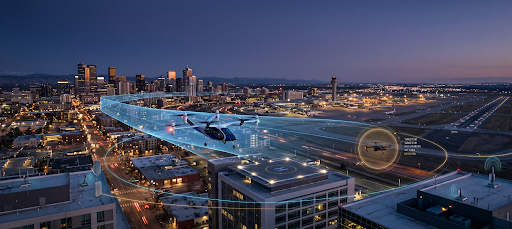
A central feature of this future will be the emergence of vertiports: urban hubs for air taxis and other AAM services. Unlike traditional airports, vertiports will be embedded closer to dense urban environments, critical infrastructure, and public gathering areas. This proximity creates new vulnerabilities, particularly in low-altitude airspace where authorized AAM operations may encounter unauthorized drones.
For that reason, counter-UAV capabilities are not merely a security enhancement; they are a prerequisite for the future of American aviation. Vertiport operators and public safety agencies must be able to detect, classify, and respond to unauthorized drones without disrupting legitimate AAM traffic. The same capabilities needed to protect airports and major events will be equally important for keeping vertiport operations safe, resilient, and commercially viable.
For AAM to succeed, the public must have confidence that the airspace around these hubs is secure. A modern policy framework can allow legitimate AAM operations to thrive while ensuring that unauthorized drones can be surgically removed from the sky without disrupting the complex traffic patterns of a 21st-century city.
Technology as the Enabler
Technology is ready to help close this gap, but policy must catch up. D-Fend Solutions’ EnforceAir is an example of a counter-UAV capability that supports this new vision. By enabling precise detection and controlled mitigation, without the collateral disruption of jamming or kinetic defeat, it aligns with the policy emphasis on safe, risk-aware mitigation around sensitive sites.
Policy enables authority, authority enables deployment, and technology enables execution. Together they form the foundation of effective counter UAV readiness in modern airspace.
Operationalizing Counter UAV Readiness
The next phase of work must focus on aligning authority, training, and approved technologies. As we move through 2026, the objective is clear: we cannot secure the future with the rules of the past.
We must build a framework that is as dynamic and innovative as the technology it seeks to manage, ensuring that federal and local partners can work in lockstep to protect people and assets before threats become catastrophic incidents.
FAQ
What is counter UAV? Counter UAV refers to the policies, technologies, and operational frameworks used to detect, identify, and mitigate unauthorized drones in sensitive environments.
Why is counter UAV authority expanding beyond federal agencies? Because drone threats are often local, new policies enable state and local agencies to respond faster and more effectively.
How does counter UAV relate to future aviation like AAM? Secure airspace enabled by counter UAV capabilities is essential for safely integrating new systems like air taxis and vertiports.


 Subscribe to email updates