Key Takeaways
October 2026 rogue drone incidents affected stadiums, correctional facilities, airports, and military installations. Across these environments, limited visibility and incomplete information complicated security decisions. Effective counter-UAS response depends on early detection, drone and pilot tracking where available, and proportionate, authorized mitigation that minimizes operational disruption.
Waiting to spot an unauthorized drone may mean reacting too late.
In dense urban venues, obstructed prison perimeters, and active airfield corridors, rogue drones rarely present a clean visual target. A pilot can launch miles away from behind buildings, trees, or terrain, leaving security teams to scramble only after a drone penetrates a perimeter, or approaches a climbing airliner.
From an airborne contraband drop directly to a prison window to an incident at 7,000 feet above a Chicago airport, October’s entries in the Drone Attack & Incident Tracker expose the cost of relying on line-of-sight awareness. Incidents like these highlight a common operational challenge: security personnel may need to make decisions based on incomplete information, without confirmation of the pilot’s identity or location, or whether the drone is carrying a payload.
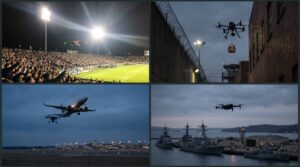
October’s incidents at a glance:
- Stadiums: unauthorized drones interrupted an NFL game and an Arsenal cup match, forcing immediate play suspensions.
- Prisons: a drone delivered McDonald’s chicken nuggets and alcohol directly to a supermax cell window in Quebec
- Airports and aviation: suspected drone sightings halted flights in Nuremberg and triggered a report outside Chicago
- Military installations: multiple unauthorized drone flights disrupted a French naval defense exercise in Toulon
Stadiums and Arenas: The Pilot Accountability Challenge
An unauthorized drone penetrated restricted airspace above Lambeau Field in Green Bay, Wisconsin, forcing an abrupt stoppage during the third quarter of an NFL matchup between the Green Bay Packers and Carolina Panthers on October 29.
With 7:43 remaining on the clock, officials halted play and directed both teams to their sidelines under standard safety protocols. While the game resumed five minutes
later once the aircraft drifted away, that wasn’t the end of the story. On November 5, local law enforcement announced that investigators had tracked down and identified the drone pilot.
Just two days earlier, a similar incident disrupted English football during one of the most high-profile events in Fleetwood Town’s history, a sold-out Carabao Cup against Arsenal on October 27. An unauthorized drone appeared above Highbury Stadium inside the opening two minutes, prompting the referee to halt the match, consult safety officers, and hold players near the touchline for an eight-minute stoppage before the aircraft cleared the area.
The Operational Takeaway
For venue security and event safety directors, managing the immediate incursion is only half the battle. Waiting for a drone to exit allows play to resume, but it leaves the venue exposed to repeat flights. Effective counter-UAS strategies require real-time tracking of both the drone and its pilot. Pinpointing the pilot’s exact coordinates enables law enforcement to deploy directly to the pilot on the ground, establish accountability, and deter future incursions across major public events.
Correctional Facilities: When Contraband Reaches the Cell Window
Canada’s highest-security facility confronted a brazen airborne delivery when a drone dropped a McDonald’s meal and alcohol directly to an inmate’s cell window at the Special Handling Unit (SHU) in Sainte-Anne-des-Plaines, Quebec, on October 15.
Correctional officers recovered the payload only after the aircraft had departed the facility. While the drop itself attracted media attention for its fast-food contents, the delivery exposed an operational vulnerability: the same flight path that drops a takeout bag could potentially deliver narcotics, communication tools, or lethal weapons directly into the hands of high-risk offenders.
The Operational Takeaway
Discovering contraband after the drop has landed supports a forensic investigation, but it fails to prevent the breach. Because optical cameras and radar struggle with blind spots created by cell blocks, exercise yards, and structural corners, correctional perimeters demand non-line-of-sight (NLOS), RF-based drone detection. Continuous monitoring of radio frequency communication links allows C-UAS operators to identify incoming flight paths well beyond the perimeter wall, providing actionable early warning before a delivery drone ever reaches an inmate-accessible window.
Airports and Aviation: Balancing Airspace Safety with Operational Continuity
A climbing commercial airliner narrowly avoided disaster when the flight crew of American Airlines Flight AA1936 reported a near-miss with a suspected drone after departure from Chicago O’Hare International Airport (ORD) on October 10. Passing through approximately 7,000 feet near Lake Michigan, the Boeing 737-800 encountered an unmanned aircraft that the captain estimated passed within 100 to 200 feet before the airliner safely continued to Newark Liberty International Airport (EWR).
Three days later, multiple pilot reports triggered widespread disruption at Germany’s Nuremberg Airport (NUE) on October 13. Three separate flight crews independently reported a rogue drone operating near active flight corridors during approach and departure. Aviation authorities suspended all runway operations and dispatched a police helicopter, though the aerial search did not visually locate the reported object.
The Operational Takeaway
These incidents demonstrate the operational tension between unverified sightings and confirmed rogue drone activity. A credible pilot report near an active runway demands prompt precautionary measures, while grounding flights triggers massive cascading delays and financial disruption.
RF-cyber detection (when and where allowed) can help empower C-UAS operators to separate false alarms from genuine airborne threats in seconds. Airfield teams can verify rogue drones without relying solely on fleeting visual sightings, while protecting critical navigation and communication frequencies from interference.
Military Installations: Forensic Attribution During Active Defense Operations
Persistent unauthorized drone flights penetrated airspace near and above French naval defense installations in the Toulon region during the Typhon joint military exercise between October 5- 16.
Naval security teams activated counter-drone defenses alongside internal security personnel. While official statements confirmed that critical infrastructure remained secure, authorities did not disclose the drone models, flight data, or whether any aircraft were recovered. A formal judicial investigation remains open.
The Operational Takeaway
Detecting an unauthorized flight confirms an airspace penetration, but it does not establish the pilot’s intent, origin, or intelligence targets. In complex defense and joint-exercise environments, forces must distinguish authorized friendly UAS, from hostile or unauthorized systems, without degrading ongoing military communications.
Safe counter-drone interdiction (when authorized) requires RF-cyber capabilities that track rogue aircraft, without requiring visual line of sight, and enable controlled retrieval to preserve physical and digital forensic evidence.
Response Without Escalation
October’s incursions prove that rogue drone threats require rapid, proportionate responses that don’t escalate risk or interrupt daily operations.
To eliminate uncertainty without collateral disruption, security teams and C-UAS operators need three essential capabilities:
- Instant classification: differentiate authorized drones from real threats and resolve false alarms in seconds, even in non-line-of-sight environments
- Pinpoint pilot tracking: trace the aircraft and locate the pilot on the ground in real time, for swift mitigation and legal accountability
- Surgical mitigation: neutralize rogue drones safely without jamming, signal interference, or falling debris
D-Fend Solutions’ EnforceAir delivers non-disruptive, non-kinetic, AI-enhanced RF-cyber takeover technology to meet these operational realities. Without relying on line of sight, EnforceAir detects and tracks unauthorized drones, pinpoints the pilot’s location, and safely routes the rogue aircraft to an authorized landing zone, protecting critical sites, while ensuring full operational continuity.
FAQ
1. How can airports verify suspected drone sightings without unnecessarily grounding flights?
RF-cyber detection (when and where allowed) can help empower C-UAS operators to separate false alarms from genuine airborne threats in seconds. Airfield teams can verify rogue drones without relying solely on fleeting visual sightings, while protecting critical navigation and communication frequencies from interference.
2. Why is drone pilot tracking important during stadium incidents?
Tracking both an unauthorized drone and its pilot helps security teams assess an incursion and enables law enforcement to locate the pilot, establish accountability, and address potential repeat flights.
3. Why is non-line-of-sight drone detection important for correctional facilities?
Prison walls, cell blocks, and other structures can obstruct visual detection. Non-line-of-sight RF-cyber drone detection can provide earlier awareness of approaching drones and help security teams identify potential contraband deliveries before they reach secured areas.
4. What capabilities support an effective rogue drone response?
To eliminate uncertainty without collateral disruption, security teams need three essential capabilities: instant classification to separate authorized drones from real threats in non-line-of-sight environments, pinpoint pilot tracking to locate the pilot in real time, and surgical mitigation (when authorized) to safely land rogue drones without jamming or falling debris.


 Subscribe to email updates