Drone neutralization covers active counter-UAS measures that disrupt, disable, destroy, redirect, or take control of an unauthorized drone. These methods do not create the same result. Some may lead to falling debris or signal disruption. Controlled non-kinetic drone neutralization systems are intended to guide supported drones to a predefined landing area. D-Fend Solutions’ EnforceAir uses RF Cyber-Takeover to support that controlled outcome without jamming or kinetic force. The required end state, operating environment, and authority for use should drive technology selection.
“Stop the drone” sounds like a clear objective. In practice, it leaves the most important question unanswered: what should happen to the drone next?
A projectile may remove an immediate airborne threat but send damaged equipment toward the ground. A jammer may block or interfere with the connection between a drone and its pilot, leaving the aircraft to follow its preset response. An interceptor UAV may entangle the target with a net, but it adds another aircraft to the operation. A takeover system aims to place the drone under the security team’s control and land it within a defined area.
All of these may be described as drone neutralization, but the method matters because the outcome matters.
What Is a Drone Neutralization System?
In counter-UAS operations, neutralization is an umbrella term for active measures intended to end or reduce a drone threat. The Federal Aviation Administration describes mitigation capabilities as those that may disrupt, disable, destroy, take control of, or provide alternate flight instructions to a UAS.
Detection Is Not Neutralization
Detection provides awareness. It may alert counter-UAS operators to drone activity, support tracking, and inform threat assessment. It does not, by itself, change the drone’s flight or end the incident.
Neutralization is the active response that follows a decision to mitigate an identified threat. Detection and mitigation may be available through separate systems or within one platform, but they remain different operational stages.
Non-Kinetic Does Not Always Mean Non-Disruptive
Non-kinetic means that a response does not use physical force. Jamming is therefore non-kinetic, but it can still disrupt legitimate communications or navigation-dependent services. Non-disruptive describes an approach designed to avoid broad effects on nearby systems. The terms are related, but they are not interchangeable.
Neutralization Approaches and Their Outcomes
Category
Intended action
Likely outcome
Main operational question
Kinetic response
Damage or destroy the UAV with physical force
Disabled or destroyed aircraft may descend or fall
Where will the UAV, payload, and any projectile land, and what ground risk may result?
Jamming or electronic response
Block a control or navigation connection
Drone follows a preset or programmed response
What will the aircraft do after the connection changes, and could the response affect nearby communications or navigation-dependent services?
Interceptor UAV
Use another UAV to entangle or physically disable the target
Target is retained, redirected, or brought down
Is there enough time, space, and tracking accuracy for a second aircraft, and what additional risk could it introduce to the surrounding environment?
Controlled non-kinetic response
Take control of a supported drone
Controlled landing in a predefined area
Does the capability support the target and authorized operating conditions?
Kinetic Counter-UAS Responses
Kinetic responses use physical force against the UAV. Projectiles and some directed-energy systems may produce a fast physical result, but the UAV, battery, payload, and potentially projectile-related debris may still descend. The U.S. Government Accountability Office identifies errant projectiles and falling UAVs as potential sources of property damage or injury. That risk changes significantly between an isolated operating area and a populated site.
Jamming and Electronic Responses
Jamming can block or interfere with the connection between a UAV and its operator. The drone may then land, hover, return toward its take-off point, or continue a programmed route, depending on its configuration. The drone may stop receiving the pilot’s commands without the response team gaining control over its next movement. Jamming and other electronic responses can also affect nearby systems, so communications and navigation-dependent services need to be considered before deployment.
Interceptor UAVs
Interceptor UAVs send another aircraft toward the target. Some use nets to retain or lower a UAV, while others collide with or physically disable it. The method adds a second aircraft to the incident and depends on detection, tracking accuracy, launch time, closing speed, and available maneuvering space. Recovery of the responding aircraft, target, payload, and net may also form part of the outcome.
Controlled Non-Kinetic Drone Neutralization Systems
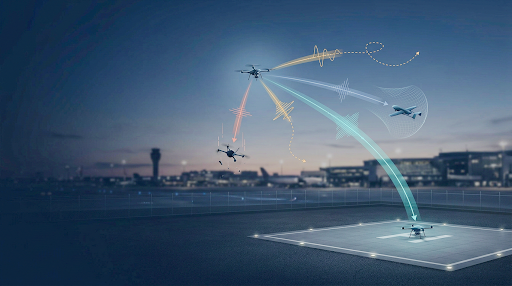
Controlled non-kinetic neutralization is intended to move from disruption to authorized control. Instead of destroying the UAV or broadly blocking signals, the response takes control of a supported drone and guides it to a predefined landing area. The intended outcome is to keep the supported drone intact and make its landing location predictable. When a supported drone is guided to a predefined landing area and recovered intact, it may also preserve the aircraft, payload, and associated data for authorized evidence handling and forensic analysis. Capability against the target, expected operating conditions, response time, training, and authority for use still need to be evaluated.
Why the Operating Environment Changes the Required Outcome
There is no single neutralization method that fits every mission. The operating environment determines which consequences are acceptable.
Airport: Communications, navigation-dependent services, and aircraft movements need to continue. A response that introduces signal disruption or debris near a runway may prolong or compound the original incident.
Stadium or public event: People, temporary structures, emergency communications, and broadcast equipment may sit below the flight path. A controlled landing area outside the crowd footprint may be preferable to an uncontrolled descent.
Critical infrastructure or correctional facility: The response may need to preserve radio communications and ongoing operations while keeping the drone and any payload away from sensitive assets.
Military or border operation: Mobility, terrain, response time, multiple simultaneous drones, and continuity may all shape the required outcome. Controlled RF cyber capabilities can operate on their own or alongside complementary technologies when the mission requires a broader architecture.
Law Enforcement: A controlled landing in a predefined area can enable recovery of a supported drone, payload, and associated data. This can support authorized evidence handling and forensic analysis.
The sector alone does not determine the answer. Evaluators need to define the acceptable end state for the specific site and incident.
What to Evaluate Before Selecting a System
Before choosing a technology, define:
Required end state: physical defeat, a system-directed or uncontrolled landing, or a controlled landing in a predefined area.
Ground and airspace risk: people, aircraft, traffic, hazardous materials, sensitive assets, and potential debris paths.
Continuity requirements: communications, navigation-dependent services, authorized drones, and operations that must remain available.
System fit: supported targets, range under expected conditions, response time, simultaneous targets, deployment configuration, training, and maintenance.
Operational authority: the organizations, personnel, equipment, and actions that are authorized for that jurisdiction and mission.
Some deployments may use a standalone e cyber capability. Others may combine complementary detection and response technologies. When a layered architecture is appropriate, RF cyber can serve as its foundational layer. Layering is an option, not a default requirement.
D-Fend Solutions and Controlled RF Cyber-Takeover
D-Fend Solutions’ EnforceAir provides RF cyber-driven drone detection. Once a supported unauthorized drone is confirmed and mitigation is authorized, its RF Cyber-Takeover capability supports a controlled landing in a predefined area without jamming or kinetic force.
EnforceAir can be deployed as a standalone cyber capability or as a foundational cyber layer within a broader architecture when complementary technologies are required. This makes the approach relevant to military, public safety, airport, border, critical infrastructure, correctional, and major-event missions where control, communications, and continuity carry particular weight.
For a detailed view of D-Fend Solutions’ capabilities and the broader technology landscape, visit the C-UAS mitigation page.
FAQ
What is a drone neutralization system?
A drone neutralization system is an active counter-UAS capability intended to disrupt, disable, destroy, or take control of an unauthorized drone. The method determines the likely flight and ground outcome.
Is drone detection the same as neutralization?
No. Detection provides awareness and supports assessment. Neutralization is the active response intended to change the drone’s flight, connection, condition, or control status after mitigation is authorized.
Are all non-kinetic drone neutralization systems non-disruptive?
No. Jamming does not use physical force, but it may affect legitimate communications or navigation-dependent services. Non-disruptive drone neutralization systems are designed to avoid broad signal disruption.
What does D-Fend Solutions’ RF Cyber-Takeover support?
EnforceAir’s RF Cyber-Takeover capability supports control of a supported unauthorized drone and guiding it to a safe landing within a predefined area, without relying on jamming or kinetic force.
What is controlled drone neutralization, and where is it relevant?
Controlled neutralization places a supported drone under the security team’s control and directs it away from protected airspace or to a predefined landing area. It may suit populated environments where falling debris and signal disruption carry serious consequences, subject to authority, target support, site conditions, and the required outcome have been evaluated.
Themis Tzamarias leads a team of system engineers at D-Fend Solutions and helps shape pre-sales engineering best practices for EnforceAir. He brings more than 30 years of experience in hardware, field engineering, and R&D, including management roles at Nortel Networks, Apple, Symantec, and Volkswagen. Drawing on this experience, he helps prospective customers evaluate EnforceAir’s capabilities and experience its ease of use firsthand.
Subscribe to email updates
Sign up here to receive the latest news, upcoming events, webinars and industry best practice resources


 Subscribe to email updates