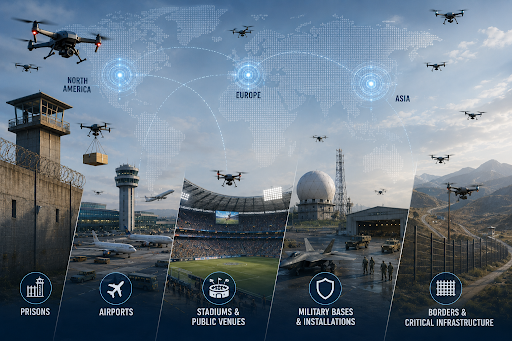
The first half of 2026 showed unauthorized drone activity that was sustained, targeted, and operationally disruptive. Unauthorized drone incidents affected airports, correctional facilities, military installations, borders, and major venues across North America, Europe, and Asia. Recurring patterns included organized prison-smuggling operations, aviation disruptions, coordinated activity near sensitive military sites, and the growing use of drones in cross-border criminal operations.
This H1 2026 analysis builds on D-Fend Solutions’ monthly Rogue Drone Incident Briefings by examining six months of activity to identify broader drone incident patterns and trends. These incidents highlight evolving tactics, frequently targeted environments, and the growing need for persistent detection, accurate identification, and controlled mitigation capabilities suited to complex operational settings.
We are not merely seeing more drones, we are seeing more targeted, sustained campaigns. From industrialized smuggling networks at correctional facilities to coordinated surveillance around military assets, the half-year (H1 2026) incidents we analyzed reveal a maturing threat landscape that demands precise, non‑disruptive countermeasures.
This briefing distills actionable intelligence from six months of recent global incidents, highlighting the nuanced patterns security and operations teams need to harden low‑altitude airspace against rogue drone threats. The goal is not merely to catalog events, but to show how widely available drones are being used and misused, and to highlight the need for more adaptable protections as the threat continues to evolve.
North America
Incidents in the first half of 2026 in North America clustered around airports, military bases, prisons, and major public venues, with threats ranging from organized contraband smuggling, to critical airspace disruptions and national security concerns.
Organized drone-smuggling networks heavily targeted Collins Bay Institution in Kingston, Ontario, triggering a massive series of seizures. Correctional staff recovered drone-dropped packages between May 20 and June 5 containing drugs, weapons, and cell phones with an estimated institutional value of nearly $687,000. Similar drops at nearby Joyceville Institution netted roughly $200,000 in contraband.
These 2026 seizures show that smuggling rings rely on industrialized, repeated high‑value delivery systems. Correctional facilities must deploy continuous, precise detection and mitigation capabilities, rather than treating each drop as an isolated anomaly.
An authorized Amazon Prime Air delivery drone crashed into the side of an apartment building in a residential neighborhood in Richardson, Texas, on February 4. This collision highlights a critical airspace management challenge: as authorized commercial drone traffic scales, security systems must instantly and accurately distinguish legitimate fleets from hostile rogue actors to prevent collateral damage.
Bad actors also tested military resilience at Barksdale Air Force Base in Bossier City, Louisiana when multiple unauthorized drones operating over sensitive areas on March 9 triggered a shelter‑in‑place order. Officials later confirmed that these were not hobbyists, but coordinated waves of sophisticated drone incursions persisting over nearly a week.
Legacy kinetic mitigation and broad-spectrum jamming introduce unacceptable collateral risks over populated, operational military bases. Without precise, non-disruptive takeover tools, strategic installations remain dangerously exposed to sustained harassment, or worse.
During the Colorado Rockies’ first homestand at Coors Field in Denver, Colorado, over half a dozen unauthorized drones breached the airspace near the stadium from April 3–5. Unauthorized flights, whether malicious or merely reckless, can inflict compounding airspace management and enforcement burdens on high‑profile venues.
Authorities seized an unregistered drone near Charlotte Douglas International Airport in North Carolina on April 25 after its pilot flew it for seven minutes near active runways for a social media post. Unfortunately, drone pilots sometimes override standard aviation safety protocols to look cool on the ‘Gram.
Drone disruptions now present a chronic operational tax to North American prisons, stadiums, airports, and military bases.
Europe
European drone incident trends in the first half of 2026 exposed persistent vulnerabilities around airports, correctional facilities, and military installations, as authorities worked to balance enforcement, continuity, and safety in dense and sensitive environments.
Authorities suspended air traffic for four hours and 27 minutes at Helsinki‑Vantaa Airport in Finland and issued an emergency drone warning across the Uusimaa region on May 15. The incident sent Finnish Air Force F/A‑18 Hornet fighters to scramble, forced the diversion of long‑haul arrivals, and affected about 450 passenger flights, demonstrating not only the safety risk, but also the significant operational and financial burden a single drone warning can impose.
Berlin Brandenburg Airport in Germany faced a similar disruption on March 11, when an unauthorized drone sighting near a helicopter hangar used by the German army prompted a temporary suspension of both takeoffs and landings for approximately 30 minutes. These suspensions show that mere sightings can paralyze complex logistics networks in Europe, even without physical impact. Military and defense sites also came under pressure. Six foreign tourists flew multiple unauthorized drones above the Ramsund naval station, the Norwegian Navy’s main base and logistics hub in northern Norway, on March 21.
European correctional facilities faced relentless, brazen smuggling campaigns. At Drama Prison in Greece, a guard spotted a rogue drone approaching during prisoners’ yard time on February 28. A drone successfully breached Larissa Prison the next day, dropping a package directly into an inmate’s hands. Prison staff thwarted a second drop on March 1 at the same facility.
Greater Manchester Police officers seized an unauthorized contraband-loaded drone bound for a prison after stopping a vehicle in Salford, UK on April 6. Additionally, officers at Chania Correctional Facility in Greece detected an unauthorized drone moving at high speed toward the inmates’ outdoor exercise yards and brought it down on June 6.
Asia
Rogue drones paralyzed critical transit hubs, triggered national security protocols, and facilitated cross-border criminal operations in Asia.
Unauthorized drone activity impacted operations at two major aviation hubs in Vietnam. At Noi Bai International Airport in Hanoi, a drone sighting on June 6 suspended departures and delayed 16 flights for about one hour. Illegal drone flights near Da Nang International Airport disrupted runway operations for about 30 minutes during the sixth day of the lunar new year’s busy Tet period on February 22. This forced 19 flights to be rescheduled or delayed. These events emphasize how quickly a single drone can force full airspace closures at busy airports, with impacts that extend well beyond the initial sighting.
Suspicious, camera-equipped drones were spotted flying over Meerut Cantonment, a restricted military zone, in Uttar Pradesh, India, on May 30. The scale of the response, including a high-level meeting on standard operating procedures, reflects heightened sensitivity to camera-equipped drones near military installations, where even unconfirmed sightings are treated as potential surveillance activity.
Border airspace security presented a different operational challenge. Border security forces (BSF) and Rajasthan police recovered an arms consignment allegedly dropped by a drone from across the border in the Khajuwala area of Bikaner district, India on February 27. Officials noted that this was the first known recovery of weapons consignment dropped by a large drone in the Khajuwala sector, highlighting how drones are now embedded in cross-border smuggling tactics.
Key H1 2026 Drone Incident Trends
The incidents reviewed for this report revealed several recurring patterns:
Sustained activity replaced isolated events. Several sites experienced repeated incursions, coordinated flights, or multiple attempts over short periods.
Correctional facilities remained persistent targets. Organized operators used drones to transport drugs, weapons, mobile phones, and other contraband.
Airport incidents caused disproportionate disruption. Even an unconfirmed or short-lived drone presence could delay flights, suspend runway activity, and divert aircraft.
Military and border environments faced increasingly coordinated activity. Unauthorized drones appeared near sensitive installations and supported cross-border weapons transport.
Authorized and unauthorized drones increasingly shared the same airspace. Expanding commercial drone operations made rapid identification and classification more important.
Operational context shaped the required response. Airports, stadiums, prisons, military facilities, and populated areas required different mitigation considerations and controlled outcomes.
Looking Forward
H1 2026 drone incidents confirm a global reality: the rogue drone threat continues to evolve faster than many existing defenses. Bad actors, from cartels to state-sponsored actors and even prison smugglers, are executing sustained, sophisticated operations across diverse environments.
The incidents documented during the first half of 2026 can provide several practical considerations for counter-UAS strategy. In many environments, conventional counter‑drone methods involve significant trade‑offs. Broad-spectrum jamming may disrupt vital airport and military communications, while kinetic solutions can introduce risks of falling debris over stadiums, neighborhoods, and critical infrastructure, as well as possible damage to planes.
Defeating today’s mature threat demands surgical precision. D-Fend Solutions’ EnforceAir counter-drone system delivers proven, non-disruptive, and non-kinetic counter-drone capabilities. Cyber-driven and AI-enhanced, it enables end-to-end detection and RF cyber-takeover for safe landings and controlled outcomes. By taking control of the unauthorized drone, security agencies can maintain uninterrupted site operations, neutralize the threat in the most complex operational environments, and gather valuable intelligence.
What are you anticipating for the second half of 2026?
FAQ
What were the main drone incident trends in H1 2026?
The first half of 2026 featured repeated prison-smuggling operations, airport disruptions, unauthorized activity near military installations, incidents around public venues, and cross-border weapons transport. Several locations experienced recurring or coordinated activity, rather than isolated drone sightings.
Which sectors were most affected by unauthorized drone incidents in H1 2026?
The incidents examined in this report primarily affected airports, correctional facilities, military installations, borders, stadiums, and other sensitive operational environments.
What impact did unauthorized drones have on airports in H1 2026?
Unauthorized drone sightings caused runway suspensions, flight delays, aircraft diversions, and schedule changes at several airports. These incidents demonstrate that even a short-lived drone presence can create significant operational disruption at a busy aviation hub.
Why is drone identification becoming increasingly important?
Authorized commercial, public safety, and recreational drones may operate near sensitive locations. Identification provides the context security teams need to distinguish legitimate activity from unknown, unauthorized, or hostile UAS.
What do the H1 2026 drone incidents mean for counter-UAS strategy?
The incidents point to the need for persistent airspace awareness, accurate identification, and mitigation options suited to the operating environment. Airports, prisons, military installations, borders, and public venues each present different operational requirements and acceptable outcomes.
Meryl Dzikansky is the Marketing Content Manager at D-Fend Solutions, where she combines analytical insight with creative strategy to develop impactful content. She closely tracks global drone incidents and trends, focusing on branding, messaging, and the evolving counter-drone landscape.
Subscribe to email updates
Sign up here to receive the latest news, upcoming events, webinars and industry best practice resources


 Subscribe to email updates