Counter-Drone Operations at a Glance
Effective counter-drone operations combine suitable equipment, prepared operators, clear procedures, defined response authority and a clearly defined incident outcome. At a major event, security teams need to detect and identify drone activity, distinguish authorized drones from unauthorized ones, assess the situation and carry out an authorized response that supports operational continuity.
Major events place unusual demands on security teams. Crowded venues, public spaces, critical infrastructure, transportation systems, communications networks, public safety operations, and multiple agencies must operate simultaneously, often across multiple locations.
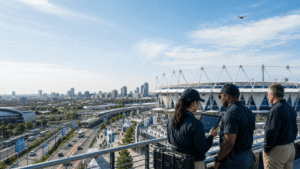
In these environments, counter-drone readiness is not only about deploying technology. It is about improving authorized teams’ situational awareness, procedures, training, and response capabilities needed to manage an unauthorized drone incident while supporting continuity of the event and its surrounding operations.
The 2026 World Cup demonstrated the importance of this preparation at scale. D-Fend Solutions’ EnforceAir was deployed extensively throughout North American host cities after being selected by 20+ national, federal, state, and local law-enforcement and public-safety agencies in the United States, Canada, and Mexico. The deployments supported protection of matches, surrounding venues, and critical infrastructure from unauthorized drone activity.
Counter-Drone Readiness Begins Before an Incident
A counter-drone system is not operationally ready simply because it has been delivered or installed. Readiness depends on whether the people responsible for the site understand what they need to detect, who makes response decisions, which actions are authorized, and what outcome the response must achieve.
At a major event, the airspace above the venue and its surrounding areas becomes an active part of the security environment. Unauthorized drones can create safety concerns, complicate public safety operations, and introduce uncertainty in areas where security teams need a clear understanding of what is operating nearby.
At the same time, major events may include legitimate drone activity for media, public safety, event operations, or other approved purposes. The task is therefore not simply to determine whether a drone is airborne. Security teams need situational awareness to identify drone activity, assess whether it requires further action, and execute an authorized response that reflects the site’s operational requirements.
Define the Required Outcome
Every site should define its required counter-drone end state before an incident occurs.
For some environments, the primary objective may be to prevent further access to protected airspace. In other environments, teams may need to consider people, aircraft, traffic, communications, critical assets, temporary structures, and ongoing operations that could be affected by the drone’s post-mitigation flight or landing outcome.
This is especially important at major events, where the airspace may sit above crowds, public infrastructure, transportation corridors, and communications-sensitive operations.
Planning should therefore account for questions such as:
- What outcome is acceptable if an unauthorized drone requires mitigation?
- Where can a drone be directed if a controlled landing is required?
- Which people, operations, communications, and assets must remain protected and available?
- Who is responsible for confirming an incident and authorizing a response?
- How will security, public safety, venue, and other stakeholders coordinate during an incident?
The goal is not simply to stop an unauthorized drone. It is to resolve the incident in a way that supports the site’s overall security mission and operational continuity.
Convert Requirements Into Procedures
Effective counter-drone operations require more than an appropriate technology selection. Teams also need clear procedures that turn site-specific requirements into a repeatable response.
This includes defining roles and responsibilities for monitoring, assessment, escalation, decision-making, mitigation authorization, and post-incident review. It also means preparing operators to understand their role within broader event-security procedures.
For a single fixed site, those procedures may involve a relatively small group of stakeholders. For a tournament or other multi-site event, the challenge becomes more complex. Different locations may have different physical layouts, surrounding infrastructure, authorized-drone activity, operating procedures, and public-safety partners.
The goal is not to make every site identical. It is to give every site a clear, coordinated approach to awareness, assessment, authorized response, and the required end state.
Prepare for Real Operating Conditions
Counter-drone training and operational preparation should reflect the conditions teams are likely to encounter during the event.
That includes the expected operating environment, local procedures, handoffs between personnel and shifts, response timing, continuity requirements, and coordination with other security and public-safety stakeholders. It also includes preparing for the fact that conditions may change during an event, including changes in crowd movement, venue activity, aircraft operations, traffic patterns, or authorized drone use.
Exercises and workflow validation can help teams identify gaps before an incident occurs. They can also build operator confidence: confidence that personnel understand their roles, that the required actions are authorized, and that the response supports the site’s defined outcome.
This preparation is particularly important when the response must account for sensitive surrounding operations. A mitigation action should be evaluated not only by whether it affects the drone, but also by what happens next.
Supporting Operational Continuity
At major events, security measures must coexist with the activity they are protecting. Matches, fan zones, public transportation, emergency communications, broadcast operations, and critical infrastructure may all need to continue while a drone incident is assessed and addressed.
That is why continuity should be built into counter-drone planning from the beginning.
D-Fend Solutions’ EnforceAir provides RF Cyber-Takeover capabilities that support detection and mitigation of unauthorized drones through a non-kinetic, non-disruptive approach. Once an unauthorized drone is confirmed and mitigation is authorized, EnforceAir supports a controlled landing in a predefined area without jamming or kinetic force.
This approach can be relevant when security teams need to consider the potential consequences of the drone’s post-mitigation flight and landing outcome, alongside the continuity requirements of the surrounding environment.
Consistency at Scale
The World Cup required counter-drone operations across a multinational, multi-site tournament footprint. That kind of environment reinforces a practical lesson for future major events: consistency does not mean uniformity.
Each venue may have different priorities, stakeholders, operating conditions, and authorized procedures. But the core elements of readiness should remain consistent:
- Persistent situational awareness.
- Clear assessment and escalation procedures.
- Defined decision-making and response authority.
- Prepared operators and coordinated stakeholders.
- A response approach aligned with the site’s required outcome.
- Consideration for operational continuity throughout the incident.
D-Fend Solutions supported the broader World Cup security effort by providing the EnforceAir system used for deployments across North American host cities. Given the sensitivity of the tournament security environment, D-Fend Solutions and its public-safety partners maintained confidentiality before and during the event.
Operational Confidence Is the Goal
The World Cup showed that counter-drone protection for a major event is not solely a question of technology. It is an operational-confidence question.
Technology must be supported by planning, trained personnel, clear procedures, coordinated stakeholders, authorized actions, and a defined outcome. When these elements work together, security teams are better positioned to assess and address unauthorized drone activity while preserving the continuity of the event and its surrounding environment.
The most important preparation happens before the drone appears.
FAQ
What role did D-Fend Solutions play in counter-drone operations at the 2026 World Cup?
D-Fend Solutions’ EnforceAir was deployed extensively throughout North American host cities after being selected by more than 20 national, federal, state and local law-enforcement and public-safety agencies across the United States, Canada and Mexico. The deployments supported the protection of matches, surrounding venues and critical infrastructure from unauthorized drone activity.
What are counter-drone operations?
Counter-drone operations include drone detection, identification, assessment, escalation, authorized mitigation and post-incident review. The exact workflow depends on the environment, threat profile, response authority and required outcome.
What should a major-event counter-drone plan include?
A major-event counter-drone plan should define the protected area, authorized drone activity, monitoring and escalation responsibilities, response authority, acceptable mitigation outcome, operational constraints and post-incident procedures.


 Subscribe to email updates