
The Counter-Drone Drill
D-FEND SOLUTIONS BLOG
In counter-UAS (C-UAS) security, drone detection is often where the conversation starts, but it shouldn’t be where it ends. Many conventional drone detectors rely on radar, optical sensors, acoustics, or RF scanning, and while these tools can identify drone presence, a drone detector doesn’t always provide all the intelligence necessary or the prerequisite steps for effective mitigation.
The challenge isn’t just spotting a drone. It’s understanding its origin, intent, and vulnerabilities in real time. This is where RF-Cyber C-UAS systems change the game. By going beyond simple detection and diving deep into radio frequency (RF) communications and other drone attributes, RF-Cyber detection provides a richer, more actionable threat picture. It enables identification of drone models, operator tracking, and even precise, non-disruptive mitigation measures, capabilities that a conventional standalone drone detector by itself often lacks.
Before discussing RF-Cyber detection, it’s important to understand the limitations of traditional drone detection methods:
While these approaches provide initial warning capabilities, they do not provide intelligence on who is controlling the drone and the operator’s location, what communication protocols it is using, or how to effectively neutralize the threat without disruption or collateral interference. Thus any mitigation efforts may be more reactive rather than proactive.
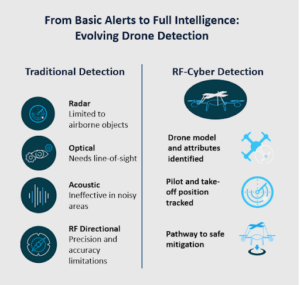
RF-Cyber C-UAS represents a technological advancement in drone detection, offering a more comprehensive understanding of drone activity by analyzing RF beyond simple identification. This includes:
Unlike radar or optical sensors, which detect or identify drones based on movement or visuals, RF-Cyber detection analyzes the radio frequency communications exchanged between a drone and its controller. This allows security teams to:
One of the biggest challenges in airspace security is determining the pilot’s or take-off location. RF-Cyber detection can also detect the remote control, providing valuable intelligence on:
Traditional counter-drone technologies, such as jamming, can interfere with legitimate communications and may be restricted by regulations in some regions. RF-Cyber C-UAS operates passively, as it listens to and analyzes existing RF activity, making it non-disruptive to other communication systems, avoiding interference with friendly operations.
This makes RF-Cyber-based drone detectors ideal for airports, urban areas, and critical infrastructure, where traditional countermeasures could create unintended disruptions.
Beyond detection, RF-Cyber technology plays a crucial role in effective threat response. Security teams equipped with RF-Cyber C-UAS systems can take informed action, including:
Drone Takeover Capabilities – Some RF-Cyber mitigation systems can override a drone’s command and redirect it safely rather than relying on destructive mitigation methods.
Drone technology is rapidly advancing. As a result, legacy drone detection methods are becoming less effective. RF-Cyber detection is a future-proof solution, capable of adapting to new drone communication protocols and providing a continuous intelligence advantage in the evolving landscape of airspace security.
Counter-UAS systems should do more than just identify drones. They should provide actionable intelligence that enhances security response strategies. RF-Cyber detection provides a seamless process between detection and mitigation, offering a deeper understanding of drone activity, operator tracking, and precision response capabilities, staying ahead of evolving aerial threats. For organizations relying on a basic drone detector alone, the gap in intelligence can be significant; RF-Cyber C-UAS could close that gap.
A drone detector is a system designed to identify the presence of drones using technologies such as radar, RF scanning, optical sensors, or acoustics. These systems provide initial alerts when a drone is detected in a protected airspace.
A standalone drone detector can identify a drone’s presence but often lacks deeper intelligence, such as the drone’s origin, operator location, communication protocols, or how to mitigate the threat effectively.
Advanced systems enhance a drone detector by analyzing radio frequency (RF) communications. This allows identification of drone models, detection of the operator or take-off location, and a better understanding of how the drone is controlled.
Basic drone detector technologies typically cannot locate the operator. However, RF-based detection can identify the controller signal and help pinpoint the operator or take-off location.
A drone detector is commonly used in sensitive environments such as airports, urban areas, and critical infrastructure, where early detection of unauthorized drones is essential.

 Subscribe to email updates
Most Popular
Military forces, airports, borders, and prisons all ...
On July 21, 2022, a drone incident at Ronald Reagan ...
As drones increasingly become a significant threat ...
Our Bloggers

Tags