Remote ID improves drone accountability by sharing identifying and location data from compliant drones. But it is not a standalone counter-UAS security solution. Because Remote ID can be absent, inaccurate, or manipulated, sensitive environments still need independent RF cyber-based detection, identification, tracking, and mitigation capabilities.
The Remote ID Paradox: We Must Support Remote ID for C-UAS…and Plan for Its Failure
Security teams around the world are asking: how can we bring accountability and visibility into increasingly crowded, low-altitude airspace?
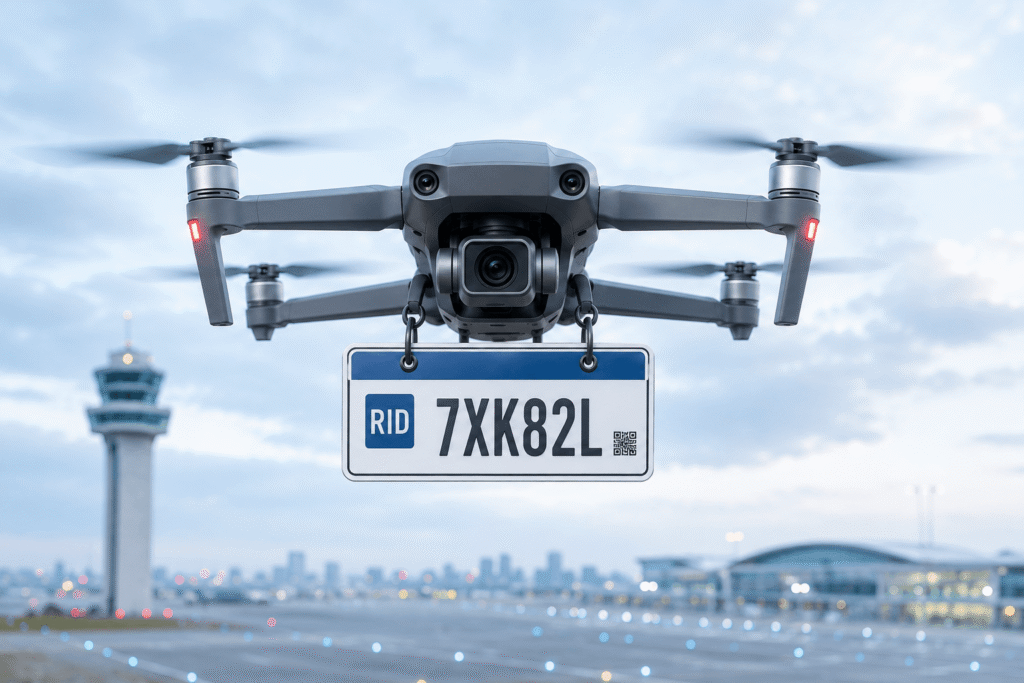
One answer is Remote ID. Often described as a “digital license plate” for drones, Remote ID was introduced to improve airspace transparency by requiring drones to broadcast identifying and location information during flight. The Federal Aviation Administration’s (FAA’s) 14 CFR Part 89 regulations became operationally enforceable in 2023 in the U.S., while Europe and other regions implemented similar frameworks.
Remote ID represents a major step forward for civil aviation authorities and drone ecosystem stakeholders. But for counter-UAS professionals tasked with protecting airports, military installations, public events, prisons, borders, and critical infrastructure, Remote ID is simply not enough. It can improve airspace awareness, but it can’t ensure that hostile drones actually comply. This blog post will show how it works…until it doesn’t.
The Promise of Remote ID
Remote ID was built to solve a growing operational challenge: The identification of drones operating legally in a shared airspace.
The concept is relatively straightforward. Drones broadcast information such as:
Drone serial number
Position and altitude
Velocity
Pilot (control station) location
This information is transmitted using standard Wi-Fi and Bluetooth protocols, and can be received by compatible monitoring systems nearby.
There are several immediate advantages for security operations. Operators in environments like airports or urban infrastructure sites are often overwhelmed by radar tracks, RF detections, and visual observations. Remote ID can help filter the operational picture by distinguishing authorized drones from unknown aircraft. This reduces false alarms, lowers operator cognitive load, and enables faster decision-making.
Remote ID also provides something many traditional sensors cannot: pilot location awareness. Radar and electro-optical systems are effective at tracking the drone, but they cannot identify the operator’s location. Remote ID broadcasts the location of the control station or takeoff point, giving security personnel actionable information for law enforcement response and operational investigation.
The technology is also relatively inexpensive and scalable. Lightweight receivers can be deployed across large areas using existing infrastructure such as poles, rooftops, or mobile vehicles, enabling broad-area drone awareness at relatively low cost.
These are meaningful advantages for cooperative airspace management. But counter-UAS security does not operate in a cooperative world…
The Problem with Trust-Based Security
The core limitation of Remote ID is not technical. It is architectural. Remote ID is fundamentally a trust-based system. It depends on drone operators willing to identify themselves honestly and comply with broadcast requirements. That works reasonably well for commercial operators, inspectors, surveyors, hobbyists, and legitimate drone users. It breaks down completely when dealing with hostile actors.
A malicious operator planning unauthorized surveillance, smuggling, disruption, espionage, or physical attack has little incentive to broadcast accurate identification information. In practice, disabling Remote ID can be remarkably simple:
Turning off the feature in modified software
Disconnecting broadcast hardware
Shielding the transmitter
Using custom-built drones without compliant modules
Drones may effectively disappear from systems that rely primarily on Remote ID for detection and identification in all these scenarios.
And that is just the beginning…
Spoofing, Ghost Swarms, and False Reality
One of the more serious concerns surrounding Remote ID is the ease with which broadcasts can be manipulated. Because Remote ID standards do not universally enforce strong physical-layer authentication, attackers can generate fake Remote ID signals using inexpensive hardware and publicly available software tools.
This creates the potential for entirely fabricated airspace pictures. An attacker can simulate dozens of fake drones simultaneously, generating what operators perceive as a large swarm attack. Security teams may respond to threats that do not exist, while real threats operate elsewhere unnoticed. Operators can also spoof false pilot locations, intentionally diverting law enforcement resources away from the actual threat location. Even replay attacks become possible. Legitimate Remote ID broadcasts can be captured and retransmitted later near sensitive facilities, creating confusion, false alarms, or even framing innocent operators.
From a security perspective, this fundamentally changes how Remote ID must be viewed. It is not a hardened security sensor. It is a cooperative awareness layer.
Why the Industry Is Moving Beyond Remote ID Alone
RF-Cyber technologies have emerged as particularly important as drone threats evolve. Unlike Remote ID receivers, RF-Cyber systems do not rely on voluntary broadcasts. Instead, they analyze and understand the unique communication attributes of the drone and its controller.
This distinction is operationally significant. Rather than depending on a drone to identify itself cooperatively, RF-Cyber technologies can independently detect, identify, locate, track, and, when allowed by regulations and performed by authorized personnel, mitigate drones through takeover and safe landing.
This enables:
Identification of drones, even when Remote ID is disabled
Detection of modified or tampered drones
Precise pilot location awareness
Close-to-zero false alarms
More informed decision-making
Controlled mitigation options
RF-Cyber-based Counter-UAS systems may use Remote ID, but they do not rely on it.
Comparing RF Detection Approaches:
Simple RF Emission Detection
Remote ID Detection
RF-Cyber
Physical mechanism
Passive RF spectrum scanning using directional finding
Passive reception of standardized Wi-Fi and Bluetooth broadcasts
Passive understanding and analysis of drone communications
Information obtained
Bearing (non-GPS accuracy)
Drone coordinates, serial number, velocity, pilot coordinates, emergency status
Drone model, serial number, location, and pilot location
Vulnerability to spoofing
Low
High
Low
Resistance to bad actors
Medium
Low
High
False alarm rate
High
Low for compliant drones; High during spoofing
Near-zero
Mitigation capabilities
None
None
Enables precise RF-Cyber takeover and controlled mitigation
The differences between these approaches are operationally significant. While Remote ID improves cooperative awareness, RF-Cyber technologies provide precise identification and controlled mitigation capabilities that do not depend on voluntary drone broadcasts.
Our RF-Cyber Approach
D-Fend Solutions’ EnforceAir C-UAS systems are built around RF-Cyber technology, enabling independent security-grade drone detection, identification, tracking, and controlled mitigation through direct analysis of drone communications.
EnforceAir systems may operate as standalone RF-Cyber solutions, or integrate RF-Cyber as a core operational layer within multi-layer counter-UAS architectures, incorporating additional detection and mitigation technologies. While EnforceAir systems can utilize Remote ID information when available, they do not rely on Remote ID broadcasts for operational effectiveness. Instead, they independently analyze drone-controller communications to provide accurate drone and pilot awareness, even when Remote ID is disabled, manipulated, or absent.
Takeaways
Remote ID is an important capability for civil drone accountability and cooperative airspace management. It improves visibility and helps reduce operational friction in increasingly crowded airspace environments. But counter-UAS security requires a different standard. Security systems cannot depend on voluntary compliance from the very threats they are designed to stop.
RF-Cyber technology should be considered a core layer for modern counter-UAS systems, enabling independent, precise detection, identification, and mitigation capabilities through direct analysis of drone communications, without relying on Remote ID broadcasts. Remote ID will remain an important complementary capability within that ecosystem. But RF-Cyber provides the foundation for reliable operational defense.
D-Fend Solutions’ EnforceAir standalone and multi-layer counter-UAS systems are built around RF-Cyber as a core operational layer, while utilizing Remote ID information when available, without relying on it for operational effectiveness.
Remote ID is a drone identification framework that requires compliant drones to broadcast identifying and location-related information during flight. It is often described as a digital license plate for drones.
Is Remote ID enough for counter-UAS security?
No. Remote ID supports cooperative airspace awareness, but it depends on compliant broadcasts. Counter-UAS security requires independent detection, identification, tracking, and authorized mitigation capabilities.
What are the main limitations of Remote ID?
Remote ID can be absent, disabled, inaccurate, or manipulated. Systems that rely primarily on Remote ID may miss non-compliant drones or receive misleading airspace information.
What role does RF cyber technology play alongside Remote ID?
RF cyber technology adds an independent security layer for drone detection, identification, tracking, and authorized mitigation. It can support operational awareness even when Remote ID data is unavailable or unreliable.
Donald Simmons is Director of Aviation Sales with 40 years in the aviation industry, spanning military, commercial, and corporate sectors. He has deep expertise in aircraft maintenance, production, management, and leading teams across North and South America. Donald is skilled in building customer relationships and driving business growth.
Ilana Brodesky, ACE, IACE, is the Director of Aviation, Public Safety, and Critical Infrastructure Business Development at D-Fend Solutions. She works organizations across North America to address the evolving threat posed by rogue drones. Leveraging her expertise in counter-drone technologies, she helps security leaders understand how to effectively detect, assess, and mitigate sUAS threats while maintaining safe, secure, and uninterrupted operations in complex and sensitive environments.
Lior Mishan leads product marketing at D-Fend Solutions, where he bridges deep-tech innovation with real-world adoption. With over 15 years of experience in emerging technologies, Lior specializes in driving the market narrative for complex solutions, helping global organizations navigate and lead through significant technological shifts.
Subscribe to email updates
Sign up here to receive the latest news, upcoming events, webinars and industry best practice resources




 Subscribe to email updates