Unauthorized Drone Activity Briefing: April 2026 Report
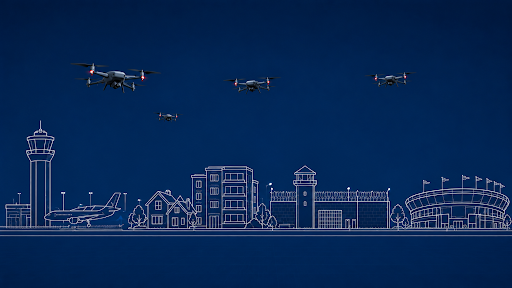
Each month, we review and analyze a representative selection of unauthorized drone activity from the Drone Attack & Incident Tracker that spans critical sectors across the globe. This series aims to give security leaders, counter-UAS (C-UAS) professionals, and operational decision-makers with a clear, factual view on unauthorized drone trends across sectors including airports and aviation, community and neighborhood environments, prisons, and stadiums and arenas. The focus throughout is on practical operational insights that can support stronger, more resilient C‑UAS strategies.
Collectively, April’s incidents highlight a clear shift toward repeated disruptions at individual hubs and the continued normalization of drones as tools for illicit delivery and evasion, rather than isolated “one-off” events.
Airports & Aviation
Unauthorized drone activity near airports can lead to significant safety concerns for commercial aircraft, often resulting in flight suspensions and broader disruption of airport operations, with major financial consequences for the aviation sector.
On April 30th, an unauthorized drone was detected over the Bogotá’s El Dorado International Airport approach corridor, forcing two arriving aircraft to execute missed approaches before operations resumed approximately 24 minutes later.
Two days earlier, on April 28, an unauthorized drone detected over the international platform at the same airport had prompted authorities to suspend all takeoffs and landings for about 45 minutes. Visual inspection protocols and on-site anti-drone systems were activated, but the operator was not located. In both incidents, the operator was not located at the time, leaving authorities without a clear point of enforcement. Colombia’s Civil Aviation Authority noted that an unauthorized drone operating within 3.5 miles of an aircraft represents a direct threat to operational safety regardless of size or intent.
Two unauthorized drone incursions at the same major hub within a single week demonstrate how quickly airports can move from rare disruptions to an expectation of repeat interference. For air traffic and security teams, that shift turns each drone sighting from a one-time nuisance into a planning assumption.
Addressing this requires purpose-built C-UAS technology capable of detecting unauthorized drone activity in real time, taking precise, non-kinetic command of rogue drones, and delivering safe, controlled outcomes that also support post-incident investigations.
Community and Neighborhood
The use of unauthorized drones in residential neighborhoods is increasingly intersecting with law enforcement activity, as low-cost commercial drones are used for illicit transport and delivery. Operating in close proximity to homes, public spaces, and shared infrastructure, these incidents introduce safety, privacy, and enforcement challenges that extend beyond traditional security perimeters.
On April 30th, a drone carrying a bag containing 66g of methylamphetamine crashed at a unit complex in New South Wales, Australia. Police responded to reports of suspicious activity and located two individuals inside the complex, who stated they were searching for the crashed drone. Officers recovered a damaged drone along with the attached package. The individuals were arrested at the scene, and subsequent searches led to the seizure of additional illicit substances and related items. This incident reflects the continued use of drones for illicit delivery activities in urban environments. It also shows how quickly drone-enabled crime can move from traditional smuggling corridors into everyday residential spaces, bringing complex C‑UAS questions to local law enforcement and community policing agencies that were never designed for airspace challenges.
Incidents like this underscore the risks posed by illicit drone deliveries in residential settings, where crashes can expose communities to hazardous materials and trigger law enforcement response. In dense neighborhoods, any mitigation approach that relies on kinetic effects or broad RF disruption can introduce its own risks, from debris hazards to unintended interference. RF-cyber counter-drone technology enables authorities to detect, identify, and take control of unauthorized drones without kinetic intervention or signal jamming, preserving public safety, protecting bystanders, and maintaining continuity of operations in complex urban settings.
Prisons
Unauthorized drones delivering contraband directly into correctional facilities present an escalating and increasingly sophisticated challenge for prison security professionals worldwide.
On April 23rd, police in France arrested an 18-year-old suspected of operating an unauthorized drone over the Riom correctional facility. Officers who responded to the operator’s location recovered the drone carrying 366 grams of cannabis resin. The individual was subsequently placed in custody for questioning. Prison officers’ union representatives note that drone deliveries at the facility are a recurring and growing concern, with about 700 mobile phones and 11 kilograms of narcotics seized across the institution in 2025 alone.
On April 14th, staff at Osborn and Cybulski correctional institutions in Connecticut, reported two unauthorized drones flying near the prison compounds, prompting an immediate search by state troopers and correctional staff.
Connecticut’s Department of Correction has noted that drone incidents near state prisons have risen, from one incident annually between 2022 and 2025, to two incidents already recorded this year. Georgia’s prisons are currently averaging 58 drone incidents per month, with unauthorized drones delivering narcotics, weapons, and mobile phones directly over perimeter walls, bypassing traditional ground-level security entirely. In this environment, precise, non‑kinetic takeover technologies, when allowed by regulations, would be particularly relevant for enabling safe, controlled outcomes without disrupting prison communications or daily operations.
Stadiums and Arenas
Unauthorized drones are an escalating threat at stadiums and arenas worldwide, creating physical safety risks, operational disruptions, and broadcast vulnerabilities during packed live events. Unauthorized commercial drones can approach venues quickly and quietly, potentially carrying hazardous payloads or capturing unauthorized footage, all while diverting critical security resources.
Between April 3–5, more than half a dozen drone sightings were reported around Coors Field in Denver, CO during the Colorado Rockies’ first homestand of the season against the Philadelphia Phillies. The sightings sent law enforcement scrambling to track down the operators. No arrests were made, but authorities issued warnings ahead of upcoming games due to the volume of violations. Even though the drone sightings did not jeopardize anyone’s safety, the number of violations raised concerns among law enforcement personnel on the ground, who believed that some operators did not appear to understand the seriousness of the situation. Authorities also emphasized that each incident requires law enforcement intervention to assess intent and ensure safety, thus disrupting operations and diverting security resources. In practice, that means that even non‑malicious flights can consume substantial time and attention from command posts, security teams, and local law enforcement, especially when sightings occur repeatedly over a series.
Stadiums and arenas of all sizes require purpose-built counter-UAS systems as a core component of event security planning. Ideally, effective solutions would detect and identify unauthorized drone activity early, take control of the threatening drones, and land them safely at a pre-designated location, allowing security teams to resolve airspace incidents in a controlled way while the wider event operation continues.
Staying Ahead
Collectively, the drone incidents recorded in April 2026 reinforce the persistent threat that unauthorized drone activity poses across multiple sectors. They also highlight two converging trends: repeated disruptions at the same locations and the normalization of drones as tools for smuggling, evasion, and opportunistic interference in everyday spaces. Security professionals require comprehensive detection and mitigation capabilities To address the risks posed by rogue drones. Staying ahead of this threat demands integrated C-UAS solutions that unite strong situational awareness with safe, predictable mitigation, ensuring rogue drones are contained before they escalate into operational crises.
For airport operators, corrections leaders, stadium security teams, and law enforcement agencies, April’s incidents are a reminder that planning for unauthorized drones is no longer optional, it’s now a core part of maintaining safe, continuous operations.
D-Fend Solutions’ EnforceAir delivers high-performance, non-kinetic, non-disruptive, cyber-driven, AI-enhanced counter-drone capabilities. Leveraging RF cyber takeover technology, it provides end-to-end detection and mitigation, supporting enhanced situational awareness, operational continuity, and safe, controlled outcomes across diverse sectors, environments, and mission-critical use cases.
Continue the monthly drone incident briefing series:
FAQ
What is unauthorized drone activity? Unauthorized drone activity refers to drone operations that occur without approval in sensitive, restricted, or operationally complex environments such as airports, prisons, stadiums, neighborhoods, and critical facilities.
Why is unauthorized drone activity a growing concern? Unauthorized drone activity can disrupt operations, create safety risks, divert security resources, and support illicit activity such as contraband delivery or unauthorized monitoring.
Which sectors were affected by unauthorized drone activity in April 2026? The April 2026 incidents reviewed here affected airports and aviation, residential neighborhoods, correctional facilities, and stadiums and arenas.
What C-UAS capabilities are needed to address unauthorized drone activity? Security teams require detection, identification, and controlled mitigation capabilities that support situational awareness, operational continuity, and safe outcomes.


 Subscribe to email updates