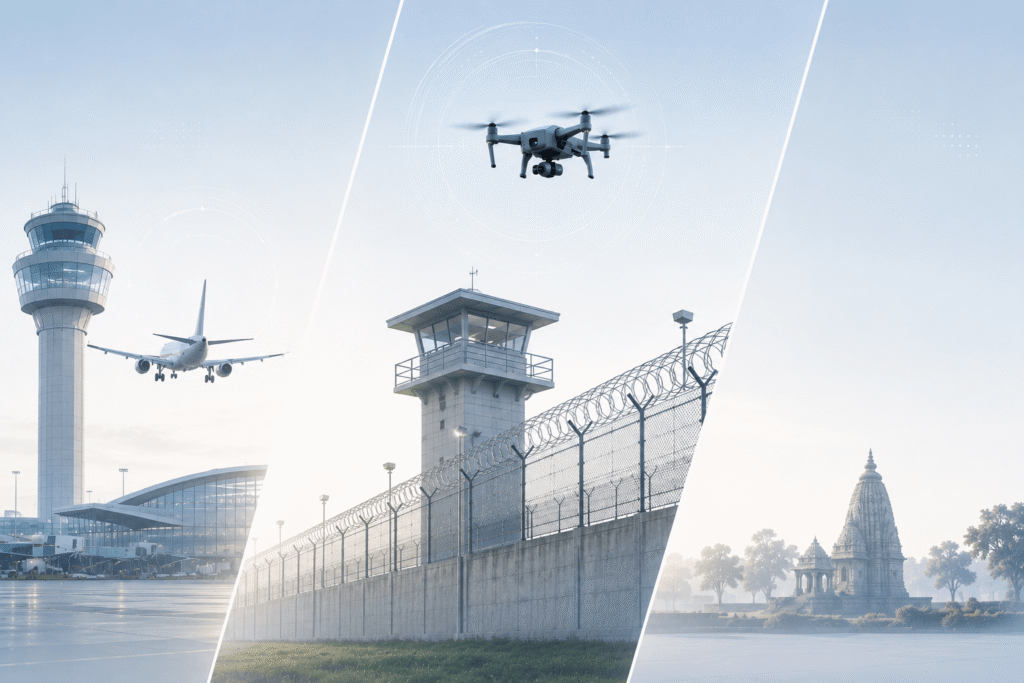
June 2026 drone incidents affected airports, correctional facilities, and protected landmarks. Across all three sectors, the pattern points to a growing need for reliable airspace awareness, accurate identification, and controlled mitigation capabilities supported by coordinated security procedures.
Drones are behaving like predictable operational variables around airports and operational facilities, forcing security teams to treat low‑altitude airspace as a core part of their risk landscape.
The June entries in our Drone Attack & Incident Tracker show consequential incidents in these three sectors.
Airports & Aviation
Unauthorized drone activity challenged airport operations throughout June, with incidents occurring in and around active approach and landing paths. Low‑altitude airspace risk should be treated as a routine consideration, rather than an exception.
A commercial pilot reported a collision with an unauthorized drone on June 29, at approximately 3,000 feet while on final approach to John F. Kennedy (JFK) International Airport in New York. A helicopter pilot reported a near miss later the same day, with a remote-controlled airplane near JFK Airport after seeing it in close proximity during flight. Two separate events near one of the world’s busiest airports show how small platforms can complicate dense airspace and quickly escalate into operational concerns for multiple types of aircraft.
Commercial pilots reported an unauthorized drone operating in their flight path while approaching the Eastern Iowa Airport in Cedar Rapids on June 3. Both aircraft landed safely and investigators identified two drone pilots working for separate contractors at a nearby construction site. They were operating drones that entered the aircrafts’ landing path without authorization. Legitimate commercial activity created unacceptable risk inside controlled airspace, underscoring that not all hazardous flights are malicious, but all demand rapid, coordinated response.
June’s airport incidents underscore that unauthorized drones near approach and landing corridors are becoming a recurring operational reality. They sit alongside birds, weather, and vehicle incursions as part of the hazard set that airport safety programs and contingency plans know they must address.
But do they know which types of counter-drone solutions are most effective?
Prisons
Correctional facilities worldwide experienced drone-enabled smuggling attempts in June, adding to a pattern of incidents in 2026.
The Grant Parish Sheriff’s Office received reports of a drone flying near the Federal Correctional Complex in Pollock, LA on June 14. Authorities seized a drone allegedly delivering contraband before it reached the facility. Investigators later recovered spare drone propellers, a drone pilot operator harness, drugs, vapes, 21 cell phones, assorted ammunition, and other items during the investigation. The spare parts, harnesses, and multi‑item payload points to an operation designed for repeat runs, not a single opportunistic attempt.
A drone dropped a package containing contraband on June 8, onto the grounds of Sing Sing Correctional Facility, in Ossining, NY, before correctional staff recovered it. After an officer assigned to the exterior grounds saw the drone and located the package, staff recovered more than 500 grams of a substance believed to be marijuana, 15 pills, earphones, and a cellphone cord. Similar to the above incident, the mix of narcotics and communication accessories suggests a deliberate effort to enhance connectivity and illicit trade inside the facility.
Drone-enabled prison smuggling is maturing into a structured supply chain, with drones, staging locations, and human accomplices all playing defined roles in a recurring process.
This means counter‑drone technology must do more than stop an aircraft – it should provide forensic data such as flight paths, likely takeoff points, and pilot locations to help dismantle the logistics networks behind each attempted delivery. Integrating counter‑drone capabilities with perimeter security, intelligence, and investigative workflows is essential to addressing both the aerial and ground components of these operations.
Landmarks and Government Buildings
Unauthorized drone activity also continued to affect protected cultural and government sites, where even a single unauthorized flight can trigger security and enforcement actions. These environments must balance open public access with the safeguarding of sensitive assets, making aerial intrusions particularly complex to manage.
Authorities arrested a man for allegedly operating an unauthorized drone on June 28 over the Lingaraj Temple, a protected monument in Bhubaneswar, Odisha, India. Police launched an investigation and seized both the drone and the motorcycle used by the accused. This incident underscores that unauthorized flights over cultural heritage sites are treated as both airspace violations and challenges to preservation regimes, carrying additional legal and reputational implications.
Unauthorized drone activity over protected heritage sites reflects the expanding range of environments confronting aerial security challenges. These sites require effective detection, identification, and controlled mitigation capabilities as part of broader security operations.
Staying Ahead
June’s incidents reinforce that unauthorized drone activity is a persistent, cross-sector challenge, rather than a series of isolated incidents. Two trends stand out: repeated disruptions at the same types of locations, especially airports and prisons, and the normalization of drones as tools for smuggling, evasion, and opportunistic interference in everyday spaces.
Security professionals require comprehensive detection and mitigation capabilities to address the risks posed by rogue drones. Staying ahead of this challenge demands integrated C-UAS solutions that unite strong situational awareness with safe, predictable mitigation, ensuring rogue drones are contained before they escalate into operational disruptions.
D-Fend Solutions’ EnforceAir delivers non-kinetic, non-disruptive, cyber-driven, AI-enhanced counter-drone capabilities. Leveraging RF cyber-takeover technology, it provides end-to-end detection and mitigation, supporting enhanced situational awareness, operational continuity, and safe, controlled outcomes across diverse sectors, environments, and mission-critical use cases.
Each month, we review and analyze a selection of unauthorized drone activities from the Drone Attack & Incident Tracker, which covers critical sectors worldwide. This series aims to provide security leaders, counter-UAS (C-UAS) professionals, and operational decision-makers with a straightforward, factual perspective on unauthorized drone trends across multiple environments. The emphasis remains on actionable operational insights that can support more effective, resilient, and scalable C‑UAS strategies.
Continue the monthly drone incident briefing series:
Which sectors were affected by drone incidents in June 2026?
Rogue drone incidents affected airports and aviation, correctional facilities, and protected cultural landmarks and government sites.
What happened near JFK International Airport in June 2026?
A commercial pilot reported colliding with an unauthorized drone at approximately 3,000 feet while approaching JFK Airport. Later that day, a helicopter pilot reported a near miss with a remote-controlled aircraft, highlighting the operational risks small platforms can create in dense airspace.
What capabilities should organizations prioritize when addressing unauthorized drones?
Organizations need accurate detection and identification capabilities that support timely situational awareness. They also need safe, controlled mitigation options suited to their environment, operational requirements, and applicable regulations.
Meryl Dzikansky is the Marketing Content Manager at D-Fend Solutions, where she combines analytical insight with creative strategy to develop impactful content. She closely tracks global drone incidents and trends, focusing on branding, messaging, and the evolving counter-drone landscape.
Subscribe to email updates
Sign up here to receive the latest news, upcoming events, webinars and industry best practice resources


 Subscribe to email updates